How to Elope
in Norway
Everything I know after 13 years of planning elopements in one of the world’s most extraordinary places.
I’ve been planning and photographing elopements in Norway for over 13 years. I’ve stood on the edge of Trolltunga in October wind cold enough to make your fingers numb. I’ve shot couples at 2am under a midnight sun that had no intention of setting. I’ve driven mountain passes in November with wedding flowers in the back seat and ice forming on the road ahead.
I know what works here. I also know what the internet gets wrong.
Most Norway elopement guides were written by photographers who visited once. They’ll tell you to go to Trolltunga, book 6 months out, and pack layers. All true. All incomplete.
This guide covers the real logistics, what the permit landscape actually looks like in 2026, how the legal paperwork works for international couples, which locations give you genuine solitude (and which ones are famous for a reason but need a plan B), what an honest budget looks like, and what to do when the weather changes on you. Because it will.
If you’re thinking about eloping in Norway, this is the only guide you need. Let’s get into it.
Pssst…You don’t have to carry this.
Eloping abroad can quickly turn into spreadsheets, permits, weather questions and second-guessing.
Instead, imagine every location vetted, every timeline built around real light and travel flow, and the entire experience both designed and photographed at an award-winning level.
You bring your story. The planning and the artistry are already handled.
Why couples choose Norway
for their elopement
Every couple I’ve taken to Norway comes back saying the same thing. Not about the specific waterfall or the exact viewpoint. They say: we felt like the only two people on earth. That feeling is real. And it takes planning to find it.
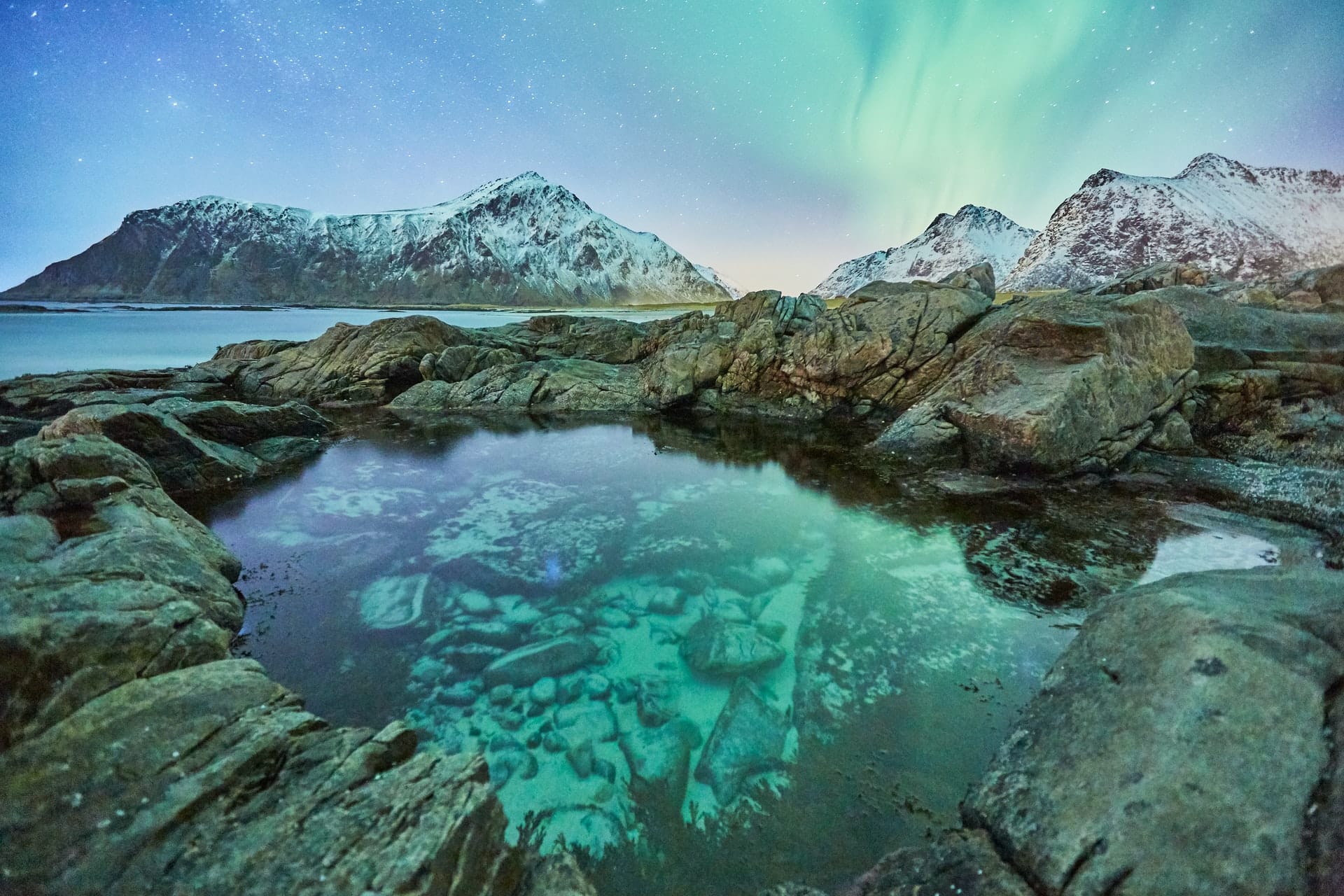
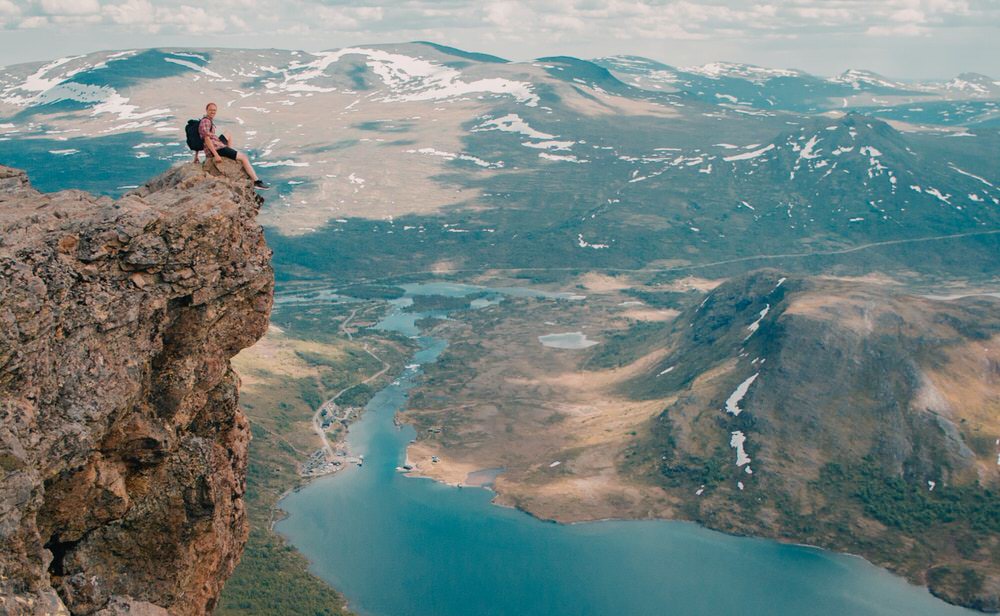
Norway is one of those places that stops being just a backdrop and starts being part of the story. The scale is hard to describe until you’re standing in it. Fjords that drop hundreds of metres straight into the water. Plateaus that go on until the horizon just disappears. Mountains that make you feel small in the best possible way.
But there’s more to it than scenery. Here are the real reasons couples choose Norway, the ones I’ve watched play out again and again over 13 years on the ground here.
Landscapes that make everything else feel small
Norway doesn’t do subtle. Fjords, glaciers, mountain plateaus, waterfalls that fall for hundreds of metres. The landscape isn’t a backdrop you pose in front of. It becomes part of your story. I’ve watched couples arrive in Norway politely excited and leave genuinely changed by it.
Allemannsretten: you can go almost anywhere
Norway has a right-to-roam law called allemannsretten that gives you freedom of movement across virtually all uncultivated land. You don’t need a permit to stand on a cliff edge, walk through a forest, or hold a ceremony beside a mountain lake. That kind of access doesn’t exist almost anywhere else in the world.
LGBTQ+ fully inclusive, no exceptions
Norway legalised same-sex marriage in 2009. The country’s culture goes well beyond the legal framework. There is no part of a Norway elopement, no venue, no ceremony, no celebration, that isn’t fully open to every couple. I’ve worked with couples of every background and orientation here and it has never once been a question.
Easy to navigate as international visitors
English is spoken widely throughout Norway, road infrastructure is excellent, and the country is genuinely easy to get around as a foreigner. Directional signs, restaurant menus, guesthouse hosts, ferry timetables. You rarely feel lost. For international couples already managing the anxiety of planning abroad, that ease matters.
A closer look at allemannsretten
The Norwegian right-to-roam is written into law under the Outdoor Recreation Act of 1957. It means you can walk, camp, and hold gatherings on uncultivated land across almost the entire country. Mountains, forests, coastlines, national parks. All of it.
For elopements, this is significant. You don’t need to book a venue. You don’t need to apply for a ceremony permit. You don’t need to ask anyone’s permission to hold your vows on a glacier or at the edge of a fjord. You just go. That level of creative freedom is almost unheard of in the destination wedding world.
The law does come with responsibilities: leave no trace, respect private farmland and garden boundaries, avoid disturbing wildlife. But if you work with someone who knows the land, those principles become part of the day rather than a limitation on it.
Norwegian light
The light here does things I’ve never seen anywhere else
I’ve photographed elopements in 24 countries. The light in Norway is different. Not better in an objective sense. Different in a way that changes what’s possible in a photograph.
In summer, the midnight sun means golden hour lasts for hours. Not the standard 40 minutes you get elsewhere. Hours. The sun moves low across the horizon, casting long shadows and warm, raking light across water and rock. I’ve shot couples at 11pm in light that looked like a film set, because nothing about it felt real.
In autumn and winter, you get the opposite. Blue hours that stretch and deepen. The kind of cool, luminous quality that makes dark fjords and snow-covered peaks look like they’ve been lit from within.
The light in Norway is not a bonus. It’s a reason to come. And it’s something I think about when building every elopement timeline I put together here.
I once watched a couple stand at a fjord’s edge at 1am in July. The sun had barely dipped below the ridge. The sky was amber and pink and still. They forgot I was there. That’s the Norway I plan elopements for.
The feeling of being the only two people in the world. It exists here. You just have to know where to look.
Zéphyr & LunaPssst…You don’t have to carry this.
Eloping abroad can quickly turn into spreadsheets, permits, weather questions and second-guessing.
Instead, imagine every location vetted, every timeline built around real light and travel flow, and the entire experience both designed and photographed at an award-winning level.
You bring your story. The planning and the artistry are already handled.
The honest truth about planning
a Norway elopement in 2026
Every guide will tell you Norway is spectacular. Fewer will tell you that the most famous spots now require booking months in advance, that shuttle buses drop hundreds of visitors at the trailhead daily, and that showing up with no plan in peak season is genuinely risky. Here’s what I tell every couple before we start planning.
Norway’s popularity as an elopement destination has grown enormously in the last decade. That’s a good thing in many ways. It means more couples are choosing meaningful, adventure-driven days over crowded receptions. It also means that some of the country’s most iconic spots have changed significantly, and most guides haven’t caught up with that reality.
I’m not going to sugarcoat it. Trolltunga, Preikestolen, and the Geirangerfjord area look very different in summer 2026 than they did five years ago. Here’s what you actually need to know.
The solitude most couples picture. It exists — but it takes knowing where to look.
Trolltunga Book early
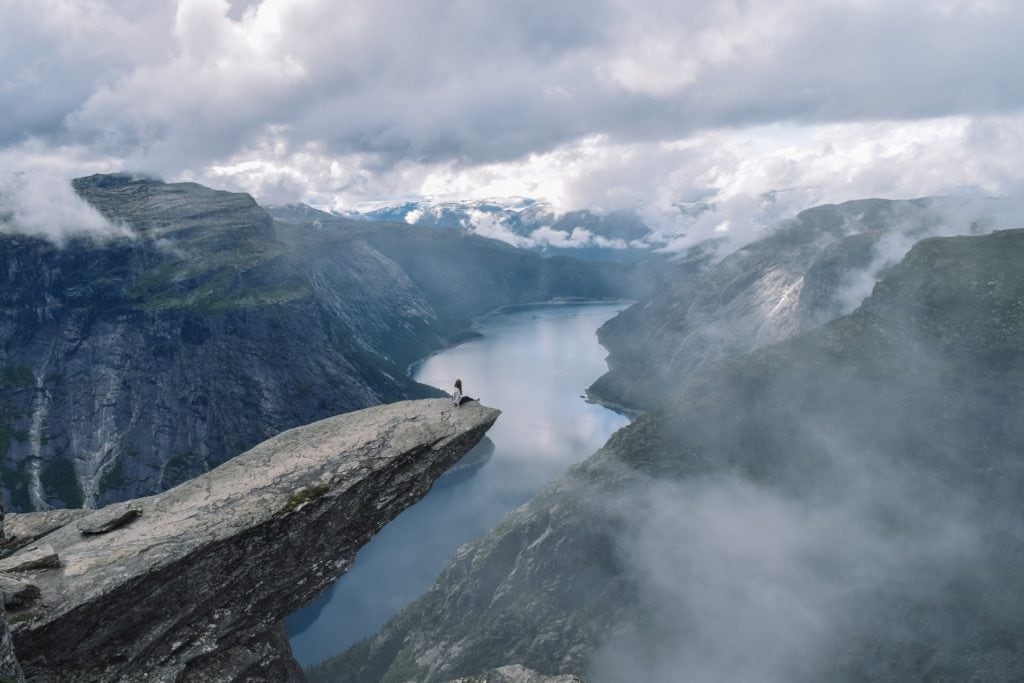
Trolltunga is one of the most photographed spots in Norway for a reason. It’s also one of the busiest. The hike is 22km and takes 8 to 10 hours return. Access is managed through a mandatory registration system during peak season (June to September), with shuttle buses from Odda required on the busiest days. Same-day or spontaneous access is not guaranteed in July and August. Plan at least 6 to 8 months out if this is your first choice — or let me find you something equally dramatic with a fraction of the crowd.
Preikestolen (Pulpit Rock) Book early
Preikestolen attracts over 300,000 visitors per year. The trailhead has a parking reservation system and on peak summer days, shuttles from Stavanger fill up fast. The rock itself is rarely empty. For elopement photography, getting a shot without other people visible requires either arriving before 6am, going in shoulder season (May or October), or accepting that your images will include other hikers. None of these are bad options — they just need a plan.
Geirangerfjord Manageable
The Geirangerfjord is a UNESCO World Heritage site and busy in summer, particularly with cruise ships docking between June and August. The fjord itself is spectacular and worth it. The key is choosing where you position for your elopement. The village of Geiranger gets crowded. The hillsides, viewpoints and surrounding valleys above it are often empty. This is a location where positioning matters more than timing.
Why hidden locations often make better photographs
After 13 years of doing this, I’ll tell you something that might sound counterintuitive: the couples whose images stop people mid-scroll are almost never at Trolltunga. They’re somewhere you’ve never heard of.
Hidden locations aren’t a compromise. They’re usually a upgrade. Here’s why.
I don’t publish my favourite hidden locations publicly. Not because I’m precious about them, but because the moment a location goes viral, it stops being what it was. If you work with me, I’ll find the right place for you specifically.
This is not Trolltunga. You’ve never seen this spot before. That’s the point.
So what does this mean for your planning?
It means one of two things. Either you book iconic locations far in advance — 6 to 12 months minimum for peak-season access at Trolltunga or Preikestolen — or you work with someone who knows the alternatives and can match you to a location that gives you the experience you’re actually after.
Both are valid paths. What doesn’t work is arriving in July with no reservations and expecting to have a spontaneous, crowd-free elopement at Norway’s most famous viewpoints. That version of Norway still exists. It just requires a different map.
I have that map. If you want to talk about what’s right for you, start here.
Pssst…You don’t have to carry this.
Eloping abroad can quickly turn into spreadsheets, permits, weather questions and second-guessing.
Instead, imagine every location vetted, every timeline built around real light and travel flow, and the entire experience both designed and photographed at an award-winning level.
You bring your story. The planning and the artistry are already handled.
When to elope in Norway:
a season-by-season breakdown
There is no wrong season to elope in Norway. There are just different Norways. The one you choose depends on what matters most to you — the light, the solitude, the landscapes, or the experience of being somewhere that feels genuinely other. Here is what I’ve seen across all four, and what I actually recommend.
Waterfalls at full force,
crowds still to come
Spring is the season most couples overlook, and the one I find myself recommending more every year. The snowmelt fills every river and sends waterfalls cascading down cliffs that will be dry by August. The peaks are still white. The valleys are turning green. The combination is extraordinary and almost no one else is there yet.
March is still deep winter in the mountains — access roads to many highland locations remain closed until late April or early May. Late April through May is the sweet spot. Temperatures are cool but workable, the landscape is at its most dramatic, and you’ll have trailheads to yourself.
The unpredictability is real. Snow can appear at any elevation without much warning. Weather can change in hours. But if you plan with flexibility built in, spring rewards you with a version of Norway that summer visitors simply never see.
Days are lengthening fast. By May you’re getting 16 to 18 hours of daylight with golden hour starting to stretch. The low sun angle creates long, dramatic shadows across snow and rock. Soft, diffused light on overcast days makes for exceptionally even, flattering portraits.
Works in your favour
- Waterfalls at their most powerful and photogenic
- Dramatically fewer visitors than summer
- Snow on peaks, green in valleys — the classic Norway contrast
- Lower prices on flights and accommodation
- No reservation systems or crowd management to navigate
Worth knowing
- Some mountain roads closed until late April or May
- Weather is genuinely unpredictable — plan for it
- Cold at elevation, especially in March and early April
Late April and May are some of my favourite weeks to work in Norway. The landscape is at peak drama, the crowds haven’t arrived, and the light is getting better every day. If your dates are flexible, seriously consider it.
Midnight sun, maximum access,
and how to work the crowds
Summer is Norway’s most popular season for good reason. Every hiking trail is open. Roads that are snowbound for months are passable. And then there’s the midnight sun — one of the most extraordinary natural phenomena I’ve photographed in 13 years of doing this work.
Above the Arctic Circle, the sun doesn’t set at all from late May through late July. Even further south, you’re working with 20-plus hours of usable light per day in June and July. Golden hour doesn’t last 40 minutes. It lasts hours. The sun moves in a low arc, casting warm raking light across water and mountain well past 11pm.
The honest part: summer is also the busiest. Trolltunga and Preikestolen have real crowd management systems (see Section 02). If you want the iconic spots in summer, book early and plan your arrival time strategically. If you want solitude, this is when having a guide who knows the alternatives matters most.
The midnight sun is the headline, but the real gift is the extended golden hour — warm, low, directional light that most destinations offer for 30 minutes. Here it runs for three to four hours. I build elopement timelines around it deliberately. Shooting at 10pm in July in Norway is not unusual. It is spectacular.
Works in your favour
- All trails and mountain roads open and accessible
- Midnight sun and extended golden hour for photography
- Warmest temperatures — comfortable at elevation
- Widest range of accommodation and vendor availability
- Best for couples who want to hike in elopement attire
Worth knowing
- Peak crowds at all famous locations
- Reservation systems active at Trolltunga and Preikestolen
- Highest prices for flights and accommodation
- Book 9 to 12 months in advance for popular dates
Summer in Norway is worth every bit of the planning it requires. The midnight sun alone justifies it. Just don’t leave it to chance — book early, build flexibility into your timeline, and if solitude matters to you, tell me. I’ll find you a location that delivers it.
Norway’s best-kept secret,
and my personal favourite
If I could give every couple one piece of unsolicited advice, it would be this: consider September. The summer crowds have gone home. The foliage turns gold and amber and rust across the hillsides. The fjords take on a moodier quality — mist settling in the mornings, dramatic skies in the afternoon. And the northern lights start appearing from late September.
September and early October are, in my opinion, the most photogenic weeks in Norway. The landscape is doing something genuinely extraordinary with colour, the light is softer and more directional than summer’s harsh midday brightness, and you can stand at viewpoints that were mobbed in July in near-complete silence.
Higher elevations get cold quickly in October, and some mountain roads begin closing from mid-October. But with the right locations, October is still entirely workable and strikingly beautiful.
The sun sits lower now. Golden hour is back to normal length but the quality is exceptional — warm, low-angle light that makes the foliage glow and reflects beautifully off fjord water. From late September, northern lights become a real possibility on clear nights, adding a layer of drama that summer simply can’t offer.
Works in your favour
- Dramatically fewer crowds — near-solitude at famous spots
- Foliage colours at peak in late September and early October
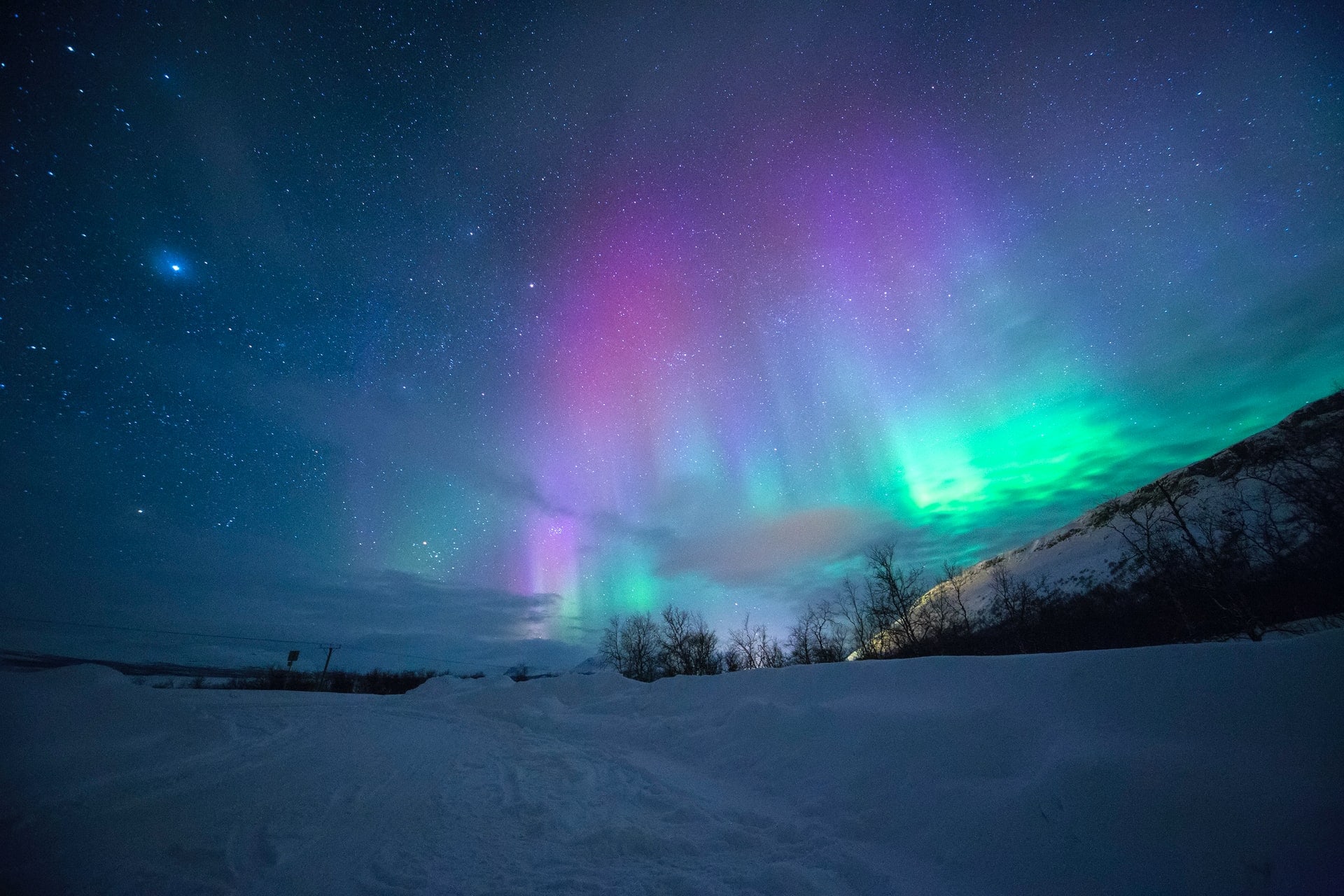
- Northern lights possible from late September
- Lower prices than summer across the board
- Moody, atmospheric light that photographs beautifully
Worth knowing
- Some high mountain roads close from mid-October
- Temperatures drop fast at elevation — layering essential
- Rain is more frequent, particularly on the west coast
Autumn is my personal favourite time to photograph in Norway. The light, the colour, the quiet. If you’re flexible on timing and solitude matters to you, September is where I’d send you without a second thought.
Northern lights, polar night,
and who this is really for
Winter in Norway is not for everyone. That is not a warning — it’s a filter. The couples who choose a Norwegian winter elopement are a specific kind of person. They want something that doesn’t look like anyone else’s wedding photos. They are drawn to stark, silent, snow-covered landscapes. They want the northern lights. They are comfortable with cold.
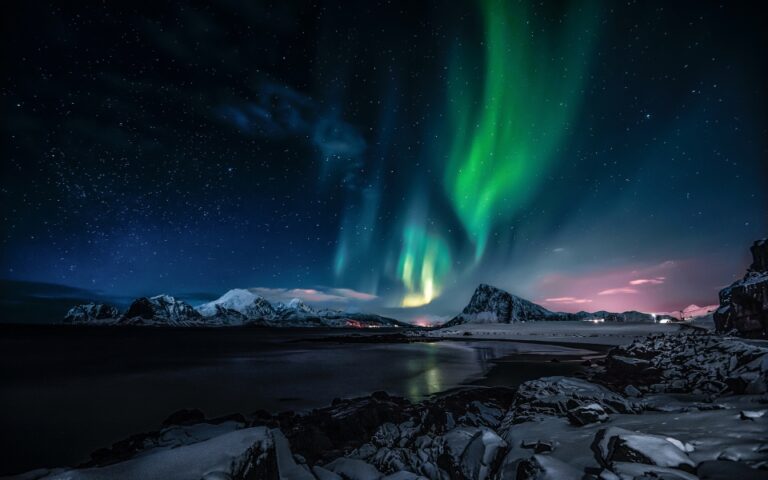
If that’s you, winter here is breathtaking. Tromsø and the Lofoten Islands are the primary destinations — both offer reliable aurora activity, dramatic winter scenery, and a density of cosy, characterful accommodation that makes the cold feel like part of the experience rather than a problem to solve.
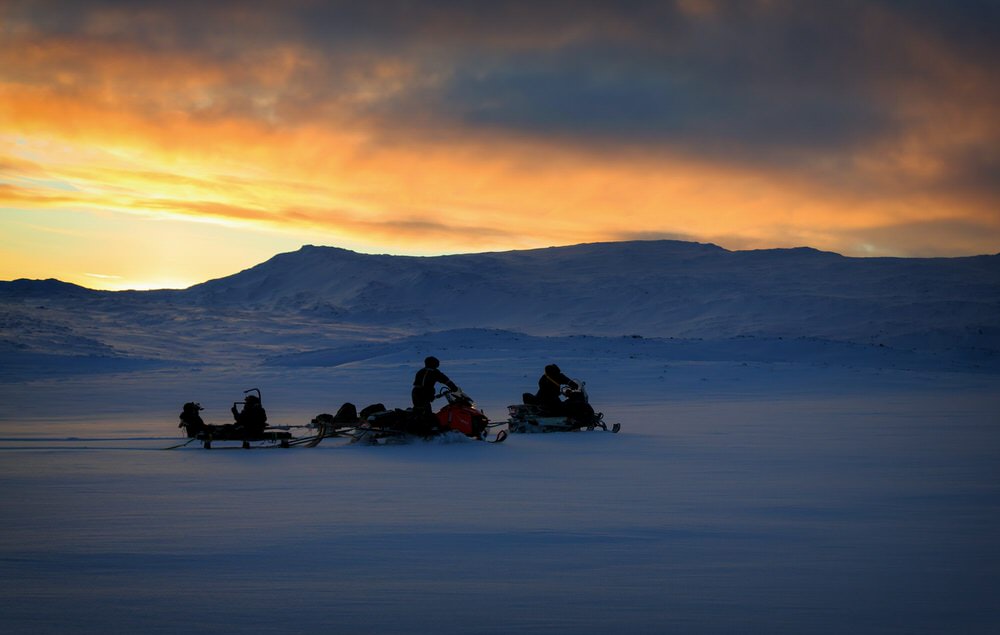
Above the Arctic Circle, polar night means the sun doesn’t rise at all for weeks in December and January. Days are lit by a long, low blue twilight that lasts a few hours and produces some of the most ethereal photography I’ve ever made. It is genuinely unlike anything else. But it requires embracing the dark rather than fighting it.
Polar night produces a long blue twilight — cool, luminous, otherworldly. Above the Arctic Circle in December, you might have two to three hours of this soft diffused light per day. Then darkness. And if conditions are right, the northern lights. It is a completely different photographic experience and one of the most beautiful things I know how to photograph.
Works in your favour
- Northern lights — peak season November through February
- Snow-covered landscapes unlike any other season
- Almost no tourists — complete solitude at most locations
- Lowest prices of the year for flights and accommodation
- Polar twilight creates extraordinary, unrepeatable photography
Worth knowing
- Very cold — serious layering and preparation required
- Most mountain hiking trails closed or dangerous
- Limited daylight hours — day structure looks very different
- Northern lights not guaranteed — forecast-dependent
Winter Norway elopements are some of the most singular work I do. If you’ve looked at aurora photos and felt something shift in your chest, trust that feeling. The couples who come in winter never wish they’d chosen summer instead.
Pssst…You don’t have to carry this.
Eloping abroad can quickly turn into spreadsheets, permits, weather questions and second-guessing.
Instead, imagine every location vetted, every timeline built around real light and travel flow, and the entire experience both designed and photographed at an award-winning level.
You bring your story. The planning and the artistry are already handled.
Where to elope in Norway –
regions and locations
Norway is not one landscape. It’s a dozen of them, each with its own character, its own light, its own version of dramatic. The right region for your elopement depends on who you are as a couple — not just which photos you’ve saved. Here’s how I think about it.
The Lofoten Islands
The iconic choice: worth it, with a plan
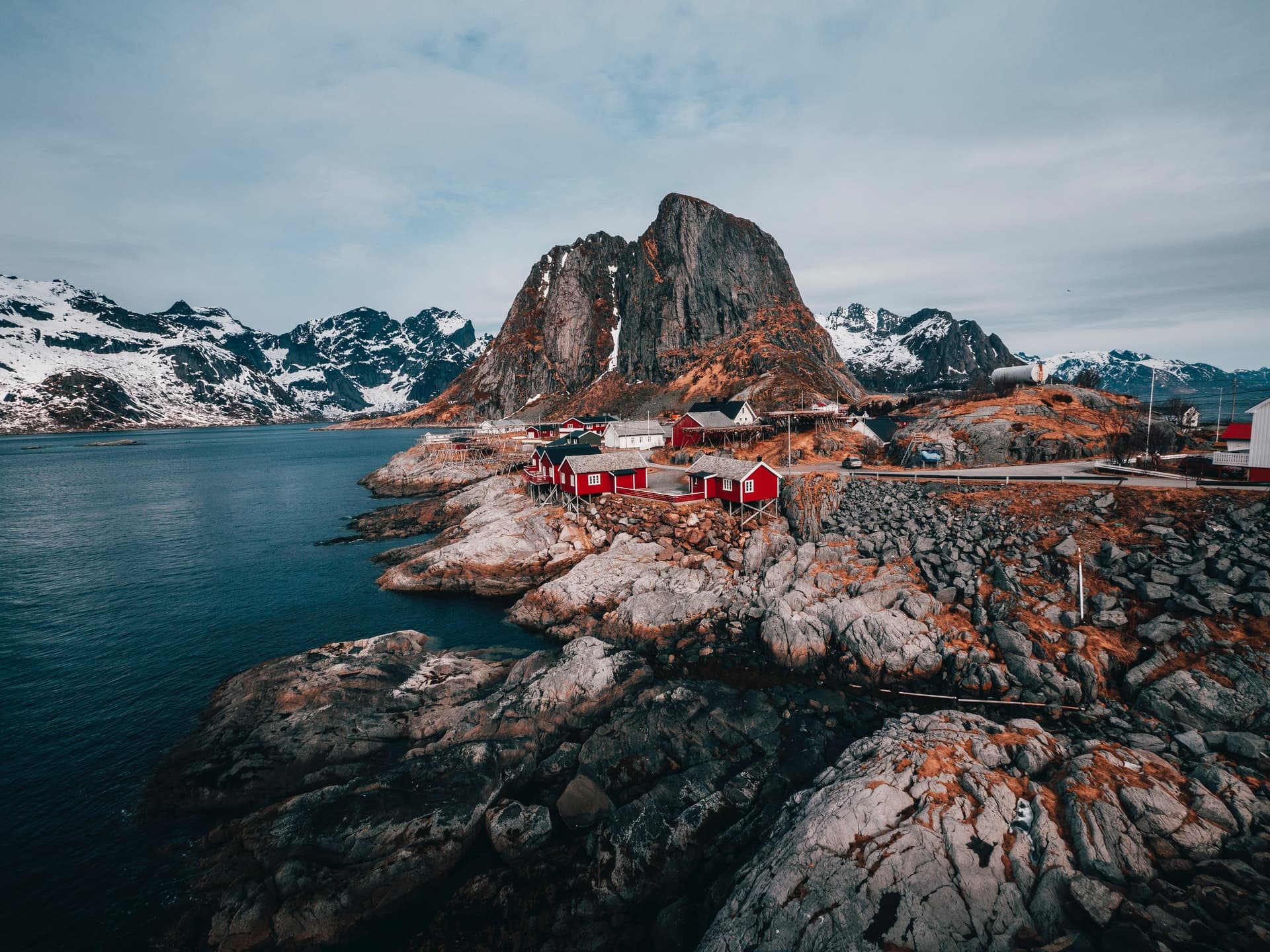
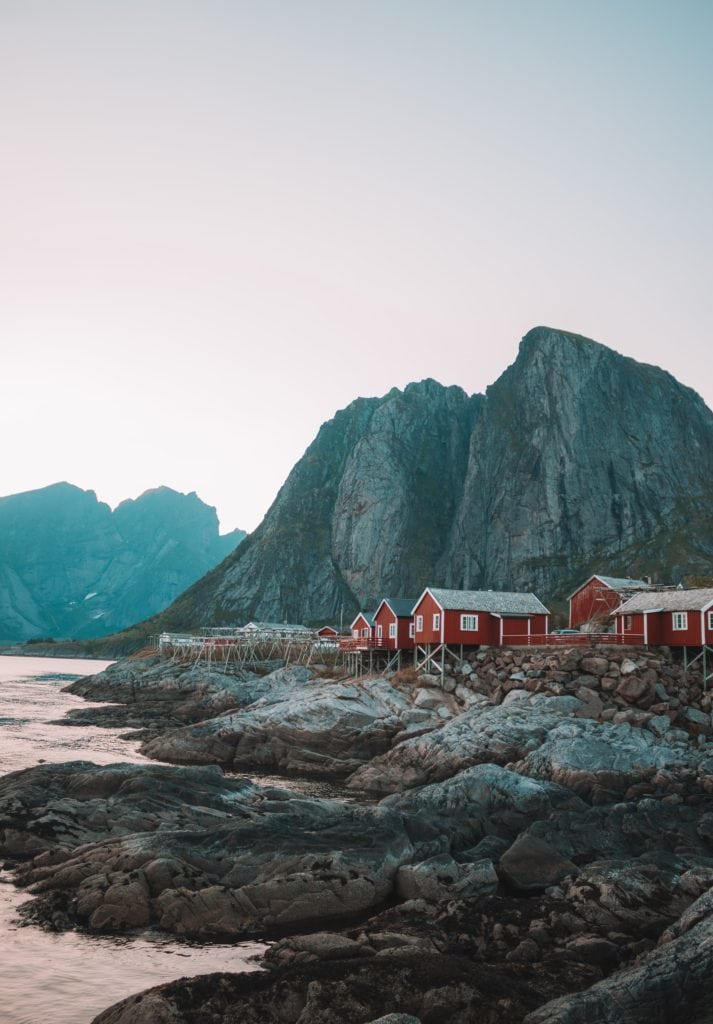
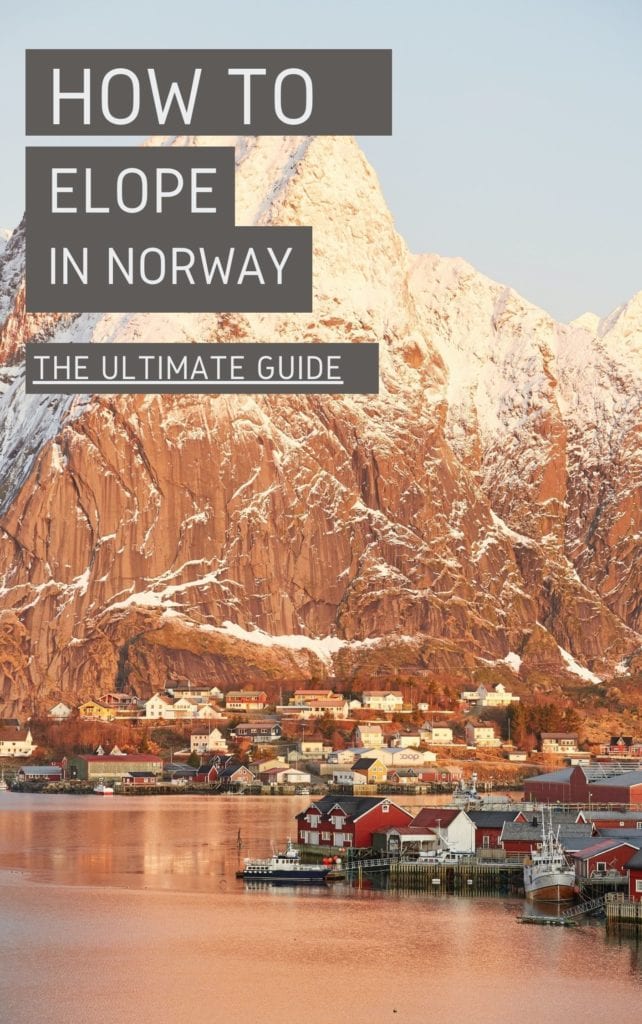
Lofoten is the image most people have in their heads when they picture Norway. Jagged peaks dropping straight into the Arctic sea. Red wooden rorbuer cabins on stilts at the water’s edge. White sand beaches that look borrowed from somewhere tropical except for the mountains behind them.
It is as spectacular as it looks. I’ve photographed there in every season and it never stops being extraordinary. The light in summer, with the midnight sun catching the peaks from every angle, is something I genuinely look forward to every time.
The honest part: Lofoten is popular. The villages of Reine, Hamnøy and Nusfjord are well-known and well-visited in summer. The trick is in the timing and the positioning — arriving at golden hour when most visitors have left, finding the headlands and valleys away from the main roads, knowing which roads lead to views that don’t appear in anyone else’s feed. That’s where I come in.
Lofoten deserves every bit of its reputation. The key is building your day around the light, not the crowds. With the right timing and locations, you can have it almost entirely to yourselves — even in summer.
Senja Island
Senja
Norway’s quieter secret –
equally dramatic, half the people
If couples ask me where to go for the Lofoten experience without the Lofoten crowds, I send them to Senja. Norway’s second-largest island sits just north of Lofoten and is, in my opinion, one of the most dramatic and underrated landscapes in the entire country.
Steep peaks fall directly into fjords. The coastline is raw and wild. The tiny fishing villages feel genuinely undiscovered. In summer, the midnight sun hits the Segla mountain and the surrounding peaks in a way that stops you mid-sentence. I have never once been there with another photographer in frame.
Senja rewards couples who are willing to drive a little further and do a little less Googling in advance. The infrastructure is lighter than Lofoten — fewer hotels, fewer restaurants — but that’s exactly why it feels the way it feels.
Senja is my honest first recommendation for couples who say they want to feel like the only people in Norway. It’s not a compromise on Lofoten. It’s a better version of the same feeling.
The Western Fjords — Geirangerfjord, Sognefjord, Hardangerfjord
Postcard Norway,
and where to find it without the postcard crowds
This is the Norway most people picture. Deep fjords carved between walls of rock that rise hundreds of metres from the water. Waterfalls threading down cliff faces. Villages perched on narrow strips of flat land between mountain and sea. The Geirangerfjord and Nærøyfjord are UNESCO World Heritage sites for good reason.
Trolltunga sits in this region, accessed from Odda near the Hardangerfjord. As I covered in Section 02, it requires advance planning in peak season — but the Hardangerfjord area surrounding it is full of quieter alternatives that deliver the same scale without the crowd management system.
Sognefjord, Norway’s longest fjord at over 200km, is consistently underused by elopement couples despite being one of the most beautiful stretches of water in the country. The small villages along its shores — Flåm, Undredal, Aurland — are genuinely lovely and far less visited than Geiranger. If you haven’t looked at Sognefjord yet, look now.
The Western Fjords region is enormous and most couples only look at a tiny fraction of it. Geiranger is spectacular but it’s not the whole story. Some of my favourite elopement locations in Norway are in this region and I’ve never seen them in another photographer’s portfolio.
Lysefjord
Lysefjord and Preikestolen
The most dramatic viewpoint
in Norway, with a realistic plan
Preikestolen — Pulpit Rock — is one of the most photographed places in Norway. A flat rock shelf jutting out 604 metres above the Lysefjord with a sheer drop on three sides. The view is genuinely extraordinary and the hike to reach it is manageable for most couples at around 8km return.
As I covered in Section 02, it receives over 300,000 visitors per year and has active crowd management including a parking reservation system in peak season. The rock itself is never empty in summer. The approach, however — the Lysefjord below, the ridgeline above it, the surrounding plateau — offers plenty of locations with equivalent drama and far fewer people.
My approach here: arrive early or go in shoulder season. A 5am start in late May or September gives you the rock almost entirely to yourself and light that most visitors never see. If that’s not possible, the broader Lysefjord area has cliff-edge viewpoints that are arguably more photogenic and never crowded.
Preikestolen is worth the planning it requires. But if you’re set on it in July, book parking months ahead and plan an early morning start. Or let me take you somewhere nearby that will look just as dramatic in your photos and feel completely different in person.
Jotunheimen National Park
The mountain lovers’ Norway:
true wilderness, no compromise
Jotunheimen translates as “the home of the giants.” It earns the name. This is the highest mountain massif in Scandinavia — home to Galdhøpiggen and Glittertind, Norway’s two tallest peaks, and to a landscape of glaciers, alpine lakes and mountain plateaus that feels genuinely remote in a way the fjords no longer quite do.
The national park covers 3,400 square kilometres. The Besseggen ridge hike is famous here but the park is enormous and most of it sees very few visitors. For couples who want an elopement that feels like an expedition — where the approach to your ceremony location is part of the experience — Jotunheimen is the answer.
The access window is narrower here than the fjords. Mountain roads typically open in late May and close again by October. Snow is possible at any time. This is genuinely high alpine terrain and it rewards preparation — but the photographs it produces are unlike anything else in Norway.
Jotunheimen is for the couples who find fjord photos a little too familiar. If you want to feel like you’ve gone somewhere genuinely far — and come back with photographs nobody else has — this is the place I’d take you.
Tromsø & the Arctic
Tromsø and the Arctic North
For northern lights
and winter elopements
Tromsø sits 350 kilometres above the Arctic Circle and is Norway’s primary base for northern lights chasing. It’s a proper city — with good restaurants, well-run accommodation and easy flight connections from across Europe — which makes it the most accessible entry point for winter elopements in the Arctic.
The aurora season runs from late September through March, with peak activity in December and January. The lights are not guaranteed — they depend on solar activity and clear skies — but Tromsø’s position and infrastructure give you the best combination of access and aurora frequency available in Norway.
In summer, the same city is locked in 24 hours of daylight, which creates an entirely different kind of elopement. The midnight sun here sits permanently above the horizon from mid-May to late July. Couples who’ve done both tell me they’re incomparable — and both completely worth it.
The surrounding region — the Lyngen Alps, the islands of Senja and Kvaløya, the fjords running north toward Finnmark — gives you endless location options beyond the city itself.
If the northern lights are on your list, Tromsø is where I’d base you. But don’t stay in the city for your elopement day — the landscapes surrounding it are where the magic happens. I’ll take you there.
A note on hidden gems
Every location above is publicly known and regularly featured in travel content. They’re all extraordinary. They’re also, to varying degrees, on other people’s radars.
I have a longer list. Locations I’ve found over 13 years of working across Norway that aren’t in anyone’s guide — including this one. I don’t publish them because the moment a place goes viral, it stops being what it was. If you want a location that’s genuinely yours, that produces photographs nobody else has, that gives you the solitude and the scale without the planning complexity of the famous spots — that’s a conversation.
Tell me what matters to you. I’ll find the right place.
Pssst…You don’t have to carry this.
Eloping abroad can quickly turn into spreadsheets, permits, weather questions and second-guessing.
Instead, imagine every location vetted, every timeline built around real light and travel flow, and the entire experience both designed and photographed at an award-winning level.
You bring your story. The planning and the artistry are already handled.
Legal vs. symbolic:
how to actually get married in Norway
This is the question I get most often: do we have to do paperwork, or can we just have a ceremony? The answer is: it depends on what you want, and both options are completely valid. Here is how I explain it to every couple I work with.
Symbolic ceremony
No paperwork, complete flexibility, legal marriage handled separately or not at all. The most common choice for international couples.
Hybrid: legal at home, symbolic in Norway
Sign the papers at home, exchange vows in Norway with no bureaucratic constraints. Best of both worlds.
Fully legal in Norway
Legally binding in Norway with a prøvingsattest, authorised officiant and two witnesses. More paperwork, fully possible.
Option 01
The symbolic ceremony,
what most couples choose
A symbolic ceremony is no less real. The vows are yours. The moment is yours. The landscape doesn’t check paperwork.
A symbolic ceremony means you exchange vows, rings, and whatever personal rituals matter to you — without the Norwegian legal framework attached. There is no paperwork required from Norwegian authorities. No prøvingsattest. No authorised officiant requirement. No two-witness minimum (though most couples invite their photographer and one other person).
What it is instead: completely yours. You can write every word of it. You can hold it on a glacier, at the edge of a fjord, at 2am under the midnight sun, in a forest, on a black sand beach. The location, the structure, the length, the language — all of it is entirely in your hands.
The ceremony is not less meaningful because it isn’t legally registered in Norway. I’ve watched hundreds of couples exchange vows in extraordinary places. The ones who felt most married at the end weren’t the ones who ticked the most legal boxes. They were the ones who were fully present.
If you want to be legally married, you can sort that at a registry office at home — before or after your Norway elopement — with none of the logistical complexity of doing it abroad. Many couples do exactly this: sign the papers at home quietly, then treat Norway as the real day.
What you need for a symbolic ceremony
From Norwegian authorities: nothing. No applications, no permits, no registration.
For your ceremony: a person to lead it (your photographer, a friend, a hired celebrant — anyone you choose), your vows or words, and the location.
For your photography: just the two of you, your attire, and time built around the light. Everything else is optional.
Most of the couples I work with choose a symbolic ceremony. Not because the legal version is too complicated, but because the symbolic version gives them the day they actually want. No schedule constraints from officiant availability. No witness recruitment stress. Just a ceremony that belongs entirely to them.
Option 03
Getting legally married in Norway
as a foreign national
It is entirely possible to get legally married in Norway as a foreigner. The process is managed by Skatteetaten — the Norwegian Tax Administration — and while it involves paperwork, it is genuinely straightforward once you understand the steps. Here is the honest version.
Apply for your prøvingsattest (marriage licence)
Before anything else, you need a prøvingsattest — the Norwegian certificate confirming you are legally allowed to marry. Apply through Skatteetaten’s foreign citizen marriage page. If both partners and both sponsors can log in with BankID, you can apply online. Most international couples apply by post. Processing takes 4 to 8 weeks — start at least 10 to 12 weeks before your date. The licence is valid for four months once issued. Postal address: Skatteetaten, Postboks 9200 Grønland, 0134 Oslo, Norway.
Gather your documents
You will need: valid passports, personal declaration forms (egenerklæring) from each partner, statements from two sponsors/witnesses (forlovererklæring, one per partner, aged 18+), and a Certificate of No Impediment from your home country — apostilled or legalised, in English or a Nordic language, no older than four months. If your country doesn’t issue this certificate, proof of civil status is accepted. Previously married? Include a declaration of division. Check Bufdir’s guidance for country-specific requirements.
Choose your officiant
Your officiant must be legally authorised to perform marriages in Norway. Friends and family cannot do this unless specifically certified. Your three main options are a civil ceremony (local municipality or city hall), a religious ceremony (Church of Norway or another registered faith community), or a humanist ceremony through Human-Etisk Forbund. The humanist option is popular with international couples — it is secular, personalised, legally binding, and can take place at a location of your choosing, including outdoors. Contact them at human@human.no. Cost: 5,000 NOK (approx. €430) for non-members.
Arrange two witnesses
A legal ceremony requires two witnesses present, both aged 18 or over. They do not need to be the same people as your application sponsors. Your photographer, videographer, or planner can act as witnesses — which is helpful if you’re eloping without guests. Just arrange it in advance so nobody is caught off guard on the day.
After the ceremony
Your officiant is legally required to notify Skatteetaten within three days of the ceremony. You will receive a Norwegian marriage certificate, which you can then have apostilled for recognition in your home country. The process for this varies by country — check with your nearest Norwegian embassy or your own country’s foreign affairs ministry for the specific steps.
Municipal ceremony
Conducted by the mayor, deputy mayor, or a judge. Usually held in a municipal office or city hall. Secular and straightforward.
Norwegian Government guidanceHuman-Etisk Forbund
Secular, personalised, legally binding. Can take place outdoors at a location of your choice. One of the few humanist associations worldwide with full legal status. Contact 6 months in advance.
human.noChurch of Norway or registered faith
For couples who want a religious ceremony. The Church of Norway performs legally binding marriages. Other registered faith communities are also authorised.
kirken.noOption 02 — Amber’s recommendation
The hybrid approach:
legal at home, symbolic in Norway
This is what I recommend to most international couples and what the majority of the couples I work with actually do. The logic is simple: sign the papers at home, then come to Norway and have the elopement you actually want.
You visit your local registry office, sign the legal documents, and you’re legally married. It takes an hour and involves no drama. Then you travel to Norway, choose your location, write your vows, and exchange them in a landscape that takes your breath away — with none of the scheduling constraints, witness logistics, or paperwork anxiety that come with doing it legally abroad.
Your marriage is completely real and legally valid. You decide when it begins. Most couples I work with say their registry office visit felt like admin, and Norway felt like their actual wedding day. That is entirely the point.
For US couples: some states allow a county clerk to authorise signing of a marriage licence abroad. If this applies to you, as an ordained minister I can legally marry you in Norway without a separate civil ceremony. Ask me and I’ll walk you through the specifics for your state.
Why most international couples choose this
No prøvingsattest required. No six-month advance booking with an officiant. No witness recruitment stress. No schedule constraints on the day.
Your ceremony location, timing and structure are entirely flexible. And your legal marriage — which is real and recognised in your home country — is already sorted before you board the plane.
I’ve planned over 300 elopements. The couples who felt most free on their day — most present, most themselves — were almost always doing a symbolic ceremony in Norway after quietly signing papers at home. The paperwork is done. The day is just theirs.
Pssst…You don’t have to carry this.
Eloping abroad can quickly turn into spreadsheets, permits, weather questions and second-guessing.
Instead, imagine every location vetted, every timeline built around real light and travel flow, and the entire experience both designed and photographed at an award-winning level.
You bring your story. The planning and the artistry are already handled.
How much does a
Norway elopement cost?
Norway is expensive. That is not a deterrent — it is information. The couples who feel most at ease going into their elopement are the ones who knew what to expect and planned for it. Here is the honest breakdown no other guide publishes.
This is what the investment looks like when it works.
The full cost breakdown
Flights
From the US: round trip to Oslo, Bergen or Stavanger. From Europe: significantly less. Book 3 to 6 months out for best rates. Main airports: Oslo Gardermoen (OSL), Bergen Flesland (BGO), Stavanger Sola (SVG).
Car rental (7 to 10 days)
Essential outside cities. A standard car starts around $400 per week. Add fuel — Norway has good roads but distances are real. Toll charges apply on many routes. Book early in summer; availability tightens fast.
Budget option — cabins and camping
Basic DNT mountain huts or campsite cabins. Norway’s allemannsretten also allows wild camping on uncultivated land for free. Budget couples can significantly reduce this line item.
Mid-range — guesthouses and rorbuer cabins
Traditional red fishing cabins (rorbuer) on stilts over the water in Lofoten. Boutique guesthouses in fjord villages. This is the sweet spot for most elopement couples — characterful, genuinely Norwegian, and not a generic hotel.
Luxury — boutique hotels and design lodges
Properties like Hotel Brosundet in Ålesund or The Thief in Oslo. Glass-front fjord cabins, mountain design retreats. For couples who want the accommodation to be part of the experience.
Elopement photographer and planner
The single most significant investment in the whole budget — and the one that makes the most difference to how the day actually feels and what you come home with. A specialist who knows Norway’s terrain, light and logistics is not comparable to a local portrait photographer. Starting price for a quality destination elopement photographer: $6,000. Full planning and photography packages with a specialist: $8,000 to $15,000+. Explore Zéphyr & Luna packages here.
Florist optional
Bouquet and buttonhole from a local Norwegian florist. Prices vary by region — Lofoten and Bergen have good options. Order well in advance; availability in remote areas is limited.
Celebrant / officiant optional
For a symbolic ceremony with a dedicated celebrant. If you choose a legal humanist ceremony through Human-Etisk Forbund, their fee is 5,000 NOK (approx. $430) for non-members. Independent celebrants for symbolic ceremonies start around $1,000.
Hair and makeup optional
In-hotel bridal hair and makeup in major cities and tourist areas. Availability in remote or rural locations is limited — book early and confirm travel fees apply. Many couples handle this themselves for simpler, outdoor-appropriate looks.
Food (7 to 10 days, two people)
Restaurant meals in Norway run $25 to $55 per person for a main course. A daily dinner out with supermarket lunches and breakfasts is realistic at $80 to $150 per day for two. Budget significantly with supermarket meals — chains like Rema 1000 and Kiwi make self-catering very manageable.
Activities and experiences
Fjord cruises ($60 to $150 per person), northern lights tours ($100 to $200), glacier walks ($80 to $150), Loen Skylift ($50 per person), whale watching ($120 to $180). Hiking is free.
Total range (7 to 10 days, two people)
Excluding optional vendors. Including flights, car, accommodation, photographer, food and activities.
Why photography is the last thing to cut
Every other line item in this budget is temporary. Flights, hotels, food, flowers — you experience them once and they’re gone. The photographs are what you live with for the rest of your life. They are what your family will look at. They are the only proof that this extraordinary day actually happened.
A Norway elopement photographer who truly knows this country — its light, its terrain, its logistics — is not an interchangeable service. The difference between an experienced destination specialist and a photographer who’s never worked here before shows up in every single image you receive.
Starting price for a quality destination elopement photographer in Norway: $6,000. Full-service packages that include planning, logistics coordination and multiple days of coverage: $8,000 to $15,000+. If a quote is significantly below this range, ask what it includes — and what it doesn’t. See what’s included in a Zéphyr & Luna package.
Budget tiers at a glance
$9,000 – $13,000
For couples who prioritise photography investment, travel simply and self-cater a lot.
- Economy flights
- Mid-range car rental
- Cabin or guesthouse accommodation
- Experienced photographer ($6,000 to $8,000)
- Supermarket meals plus a few restaurant dinners
- Free hiking, no extra vendors
$13,000 – $20,000
The sweet spot for most couples. Comfortable, memorable, with the photography investment they deserve.
- Direct flights or business class from Europe
- Rorbuer cabin or boutique hotel
- Full photography and planning package
- Florist and celebrant
- Regular restaurant dinners
- 1 to 2 paid activities
$20,000 – $35,000+
All-inclusive, fully handled. Every detail planned. Arrive and be present.
- Business class or premium flights
- Design lodge or luxury hotel
- Multi-day photography and planning
- Full vendor team: florist, celebrant, hair and makeup
- Private dining experiences
- Concierge activities and transfers
Norway is not the cheapest place to elope. But it is one of the few places on earth where the landscape is so extraordinary that most couples, when they look at their photographs a year later, say they would spend every penny again without hesitation. Budget for what matters most. Protect the photography line. And if you want help building a plan around your actual numbers, that conversation is free.
Pssst…You don’t have to carry this.
Eloping abroad can quickly turn into spreadsheets, permits, weather questions and second-guessing.
Instead, imagine every location vetted, every timeline built around real light and travel flow, and the entire experience both designed and photographed at an award-winning level.
You bring your story. The planning and the artistry are already handled.
What to wear for your
Norway elopement
Most guides tell you to “be practical and pack layers.” That is not wrong. It is also not useful. After 13 years of photographing couples in Norwegian landscapes, I have a lot of specific opinions about what works, what photographs beautifully, what ruins an otherwise perfect day, and what nobody warns you about until you’re standing on a wet cliff edge at altitude.
For the dress wearer
Dress styles that actually work in Norway
Movement is everything. A dress that flows in Norwegian wind photographs in a way that nothing structured ever can.
The most common question I get from brides is some version of: can I actually wear a real dress for this? The answer is yes, with intention. The key is choosing a dress that was designed to move, not one that was designed to stand still in a ballroom.
Norway’s wind is real. It is also, from a photography perspective, one of the best things that can happen to a flowing dress. Fabric that catches the wind creates photographs that nobody can replicate in a studio. Chiffon, georgette, lightweight crepe, soft tulle. These fabrics move. They photograph beautifully. They work.
What does not work: heavy structured bodices that restrict movement on a hike, cathedral trains that drag through mud and catch on rocks, rigid skirts that photograph as stiff and flat. You do not need to sacrifice beauty. You need to choose it differently.
Flowing, lightweight fabrics
Chiffon, georgette, soft tulle, crepe. They move in the wind and drape beautifully in any terrain.
A-line or flowy skirts
Easy to walk in, easy to hike in, easy to sit down in when you want to take a moment. Practical and beautiful.
Separates: skirt and top
Practical for layering and for any bathroom situation in the field. A flowy skirt with a delicate top photographs as beautifully as a full gown.
Cathedral or long trains
They drag. They tear. They get wet and muddy within the first five minutes on any trail. If the train is detachable, that is a different conversation.
Heavy structured ballgowns
They restrict movement on uneven terrain and photograph as stiff in open landscape. Built for a grand staircase, not a fjord edge.
White in wet or muddy conditions
Ivory, cream and blush hold up better. Pure white picks up every grass stain and water mark. Worth considering, especially in spring and autumn.
The couples whose images I love most are almost always wearing something that has movement to it. Not because it looks bridal in a traditional sense, but because in a landscape that is constantly in motion, a still, structured dress looks out of place. Bring something that can move with Norway, not against it.
Footwear
The hiking boot and swap strategy
Shoes are where most couples make their biggest practical mistake, and it almost always happens the same way: they bring beautiful heels they cannot walk in, or they bring hiking boots and feel underdressed for their ceremony photographs.
The answer is not one or the other. The answer is both. I call it the swap strategy and I recommend it to almost every couple I work with in Norway.
You hike in broken-in, waterproof hiking boots. You arrive at your ceremony location. You swap. For the ceremony and the portraits, you wear whatever shoes you love. Heels, embellished flats, clean white trainers, barefoot if the ground allows. Then you swap back for the hike out.
The swap takes ninety seconds. It changes how you feel and how you look in the photographs entirely. And it protects your feet and your beautiful shoes from the 45 minutes of wet grass and uneven rock that precede the moment.
What to pack for shoes
Hiking boots (worn for travel): waterproof, broken in at least 4 to 6 weeks before the trip. This is non-negotiable for any location involving a trail or uneven terrain. Blisters on an elopement day are avoidable.
Ceremony shoes (packed in your bag): whatever makes you feel most yourself. Heeled sandals, delicate flats, ankle boots, simple white trainers. They travel light, they only go on for the ceremony and portraits, and they make a significant difference in the final photographs.
I have never had a couple regret the swap strategy. I have had a couple regret not doing it. Pack both pairs. Your feet and your photographs will thank you.
For both partners
The layering reality and what to actually pack
Norwegian weather is not unpredictable in the sense of being random. It is unpredictable in the sense that it changes faster than you expect, at every elevation. A sunny morning in the fjords can become a cold, windy afternoon on a ridge. A mild September day can drop ten degrees in two hours above 1,000 metres.
The principle that solves all of this is layering. Not “bring a warm coat.” Actual, thoughtful layering that you can add and remove throughout the day without ruining your outfit.
Base layer
Merino wool or moisture-wicking technical fabric. Worn directly against the skin. Keeps you warm when it is cold and regulates temperature when hiking. Do not skip this in spring, autumn or winter.
Mid layer
A lightweight fleece or down gilet. Packable enough to go in a small bag when you do not need it. This is the layer you add at the ceremony location and remove on the hike back.
Outer shell
Waterproof, windproof, packable. Worn for the approach, removed at the ceremony. I recommend a neutral or muted colour that does not clash violently with your attire if it appears in any photographs.
What partners and grooms actually wear
The best elopement suits I have photographed share one thing: they work with the landscape rather than against it. A well-fitted suit in a neutral tone, earthy linen, soft grey or deep navy looks extraordinary against fjord blues, green hillsides and stone. Slim tailoring moves better on rough terrain than boxy cuts.
For the outfit beneath: a simple shirt, no tie, or a turtleneck in cooler months. The turtleneck in particular photographs beautifully in Norway’s autumn and winter light and layers practically under a jacket.
The cardinal rule for partners: whatever you wear, make sure it fits. An ill-fitting suit in a spectacular location is still an ill-fitting suit. Get it tailored if necessary. It is worth it.
What not to bring
A long train in any muddy season
Spring and autumn terrain is wet. Trains drag through everything. Detachable only.
New, unbroken shoes for hiking
Blisters on an elopement day are completely avoidable. Break everything in at home first.
Neon or bright synthetic outer layers
They appear in transition shots and behind-the-scenes moments. A neutral waterproof shell is worth it.
Overly formal, stiff tailoring
It reads as out of place in an outdoor landscape and restricts movement on rough terrain.
The photographer’s note
Norway’s light flatters, here is what to lean into
This is what Norwegian golden hour does to soft, natural-toned fabric. You cannot replicate it anywhere else.
After 13 years photographing in Norway, I have a clear picture of what works in this specific light. The golden hour here is warm, low and directional. It catches texture, creates depth in fabric and makes skin glow in a way that harsh midday light never does.
The colours that photograph best in Norwegian light are natural, earthy and muted. Ivory, warm cream, sage, terracotta, dusty rose, deep navy, stone grey. These tones absorb and reflect the warm golden light rather than competing with it. They also sit harmoniously against the blues, greens and greys of the landscape itself.
What to avoid from a photography perspective: very bright white in golden or overcast light (it can blow out and lose detail), stark black in dark conditions, and highly saturated colours that compete visually with dramatic skies and water.
Colours that work in Norwegian light
In autumn and winter, Norway’s light is cooler and more diffused. Deeper, richer tones work beautifully here — burgundy, forest green, deep cream, charcoal. The contrast between a warm-toned outfit and a cool, misty Norwegian winter landscape is one of my favourite things to photograph.
If you tell me where and when you are eloping, I will tell you exactly what will photograph best in that light. It is part of the planning conversation I have with every couple. You do not need to figure this out alone.
Pssst…You don’t have to carry this.
Eloping abroad can quickly turn into spreadsheets, permits, weather questions and second-guessing.
Instead, imagine every location vetted, every timeline built around real light and travel flow, and the entire experience both designed and photographed at an award-winning level.
You bring your story. The planning and the artistry are already handled.
Planning your Norway elopement day:
logistics that matter
This is the section most couples skip and then wish they had read. The landscapes in Norway are extraordinary. Getting to them smoothly, staying somewhere that feels right, and having a day that flows without anxiety requires planning that has nothing to do with romance and everything to do with logistics. Here is all of it.
Timing
How far in advance to book everything
The single most common mistake I see from couples planning a Norway elopement is underestimating how far in advance things book up, particularly in peak season. Norway’s best accommodation is not a hotel with 200 rooms. It is a rorbu cabin in Lofoten with six units, or a mountain lodge with twelve. These fill up fast and they do not hold.
For a summer elopement, 12 to 18 months in advance is not excessive. It is realistic. For shoulder season (May, September, October), 6 to 9 months is generally workable. For winter, 6 months is usually sufficient except for the most sought-after properties in Tromsø during aurora season.
Flights and entry
Getting to Norway: which airport to fly into
Norway rewards the couples who get behind a wheel. Most of what makes this country extraordinary is only reachable by road.
Which airport you fly into shapes the first days of your trip significantly. Norway is a long country and internal travel takes time. The right entry point depends on where your elopement is happening.
Most international connections. Best starting point if you plan to drive north toward Jotunheimen, explore the south, or connect to a domestic flight to Lofoten or Tromsø.
Best for: Jotunheimen, drive north, domestic connections
Gateway to the Western Fjords. Fly in and you are 2 hours from Hardangerfjord, 4 hours from Geirangerfjord. The most logical entry for fjord-based elopements.
Best for: Western Fjords, Hardangerfjord, Geiranger
Stavanger Sola
Best entry point for Lysefjord and Preikestolen. Smaller than Oslo and Bergen but well-connected from most European hubs. 40 minutes from the Preikestolen trailhead.
Best for: Lysefjord, Preikestolen, Rogaland
Visa requirements
Norway is part of the Schengen Area but not the European Union. Citizens of the EU, EEA, US, UK, Canada, Australia and many other countries can enter visa-free for up to 90 days. Check your specific requirements at UDI.no, Norway’s Directorate of Immigration. Requirements can and do change, so verify before booking.
On the ground
Getting around Norway: everything you need to know about driving
A car is not optional for most Norway elopements. Full stop. Public transport connects cities and major towns, but the fjord edges, mountain viewpoints, waterfall paths and remote coastlines where the best elopement locations exist are only reachable by road.
The good news: Norway’s roads are excellent. Well-maintained, well-signposted, and scenic in a way that makes the driving genuinely part of the experience. The E16, Fv55 (Sognefjellsvegen), the Atlantic Road, the Trollstigen. These are not just routes. They are destinations.
Book your car rental as early as possible for summer, especially if you are heading to Lofoten. Availability tightens fast in July and August and prices rise significantly. Discover Cars and Rentalcars.com both aggregate good rates for Norway.
What to know before you drive in Norway
Mountain pass closures: Many high-altitude roads close from October or November and reopen in May or June. Check Statens vegvesen (the Norwegian Road Administration) for current road status before any mountain route.
Toll roads: Norway has an extensive electronic toll system. Rental cars are generally enrolled automatically but charges accrue. Ask your rental company how they handle tolls.
Speed limits: 80 km/h on main roads outside towns, 50 km/h in built-up areas. Speed cameras are common. Limits are taken seriously.
Ferry crossings: Many fjord routes require short ferry crossings. These run regularly, take 10 to 30 minutes and are a beautiful part of the journey. Check Norled or Fjord1 for timetables.
Tunnels: Norway has some of the world’s longest road tunnels. The Laerdalstunnel is 24km long. Perfectly safe, well-lit and absolutely worth it.
Accommodation
Where to stay in Norway, by style and region
Where you sleep shapes the whole feeling of your trip. Norway has extraordinary accommodation options that go well beyond generic hotels. The ones that photograph beautifully, feel genuinely Norwegian and give you direct access to landscape are worth knowing about.
Rorbuer cabins
Lofoten
Boutique hotels
Fjords and cities
Mountain cabins
Jotunheimen and highlands
Design lodges
Arctic and luxury
I always recommend staying as close to your elopement location as possible for at least one night. Arriving at your ceremony location fresh, without a two-hour morning drive, changes the quality of the day entirely. It is worth planning accommodation around that logic even if it costs a little more.
The day itself
Building a flexible day-of timeline and planning for weather
A Norway elopement day is not a wedding timeline. There is no reception to get to, no guests waiting, no catering truck arriving at 6pm. The day belongs to you, and that is the whole point. What it does need is a loose structure built around one fixed anchor: the light.
I build every elopement timeline backwards from golden hour. What time does the sun start dropping? Where does it land on this specific location at this time of year? How long does it take to hike in? Those answers determine when we leave, when we arrive, and how much time we have. Everything else flows around that.
Weather in Norway requires a Plan B. Not because bad weather ruins elopements (it rarely does, and often makes the most interesting photographs), but because some locations become unsafe in high wind or heavy rain. I always identify an alternative location within the same general area before every elopement day. We have never needed to use it. But having it removes the anxiety entirely.
A sample summer elopement day
Slow morning
Breakfast at your rorbu or guesthouse. No alarm panic. Hair and makeup if booked. No rushing.
Drive and arrive
Travel to the general area. Lunch along the route. Arrive at the trailhead or access point mid-afternoon.
Hike in and explore
Comfortable layers, hiking boots, take the time. These walking shots are some of the most natural of the day.
Ceremony and portraits
Shoe swap. Flowers out of the bag. Vows in the location we planned. Golden hour starting to build.
Midnight sun portraits
In June and July, the sun is still above the horizon. The light at this hour is extraordinary and unhurried.
Dinner
Late dinner together, somewhere with a view if possible. This is the moment you finally sit down and take it all in.
Responsibility
Allemannsretten and Leave No Trace
Norway’s right-to-roam law gives you extraordinary freedom. It comes with one condition: you leave things exactly as you found them. This is not a guideline. It is part of the legal framework and it is taken seriously by Norwegians.
What Leave No Trace means in practice for your elopement
Take everything out that you bring in. Flower petals, ribbon, confetti, packaging from your bouquet. Every item. Nothing gets left at the location.
No campfires in summer. Fire bans apply across large parts of Norway from April 15 to September 15 in forested and heathland areas. Check Miljødirektoratet for current restrictions before planning any fire element.
Stay on established paths where they exist. Off-trail walking in fragile alpine and coastal environments causes erosion that takes decades to recover. If there is a path, use it.
Wild camping is permitted under allemannsretten at least 150 metres from the nearest dwelling, for up to two nights in the same spot without landowner permission. In mountains and remote areas, longer stays are generally fine.
The couples I work with care about this. Most of them chose a Norway elopement in part because they value wild places. Treating the landscape with respect is not a constraint on the day. It is part of the point of it.
I have never had a couple feel like Leave No Trace principles got in the way of their elopement. When it is built into the planning from the beginning rather than added as an afterthought, it is invisible. The locations stay beautiful for the next couple because the ones before them respected them. That matters to me and it matters to the couples I attract.
Pssst…You don’t have to carry this.
Eloping abroad can quickly turn into spreadsheets, permits, weather questions and second-guessing.
Instead, imagine every location vetted, every timeline built around real light and travel flow, and the entire experience both designed and photographed at an award-winning level.
You bring your story. The planning and the artistry are already handled.
Your questions answered:
Norway elopement FAQ
Thirteen years of working with international couples means I have heard every version of every question. Here are the ones that come up most often, answered plainly.
Yes, foreigners can legally marry in Norway. You need to apply for a prøvingsattest (marriage licence) through Skatteetaten, the Norwegian Tax Administration, along with a Certificate of No Impediment from your home country and personal declaration forms from each partner. Processing takes 4 to 8 weeks.
That said, most international couples I work with choose a symbolic ceremony instead, which requires no Norwegian paperwork at all. You can always sign your legal documents at home before or after your Norway elopement. See Section 05 for the full breakdown of your options.
No permit is required for a ceremony on uncultivated land in Norway. The allemannsretten (right to roam), enshrined in the Outdoor Recreation Act of 1957, gives everyone the legal right to access and use virtually all uncultivated land across the country. This includes national parks, mountain plateaus, coastlines and forests.
You can hold a ceremony anywhere this law applies without permission from any authority, public or private. Leave No Trace principles apply: take everything out with you, leave the location exactly as you found it.
Yes, Norway is one of Europe’s most expensive destinations. A realistic total budget for a 7 to 10 day Norway elopement including flights, car rental, accommodation, photography and food ranges from $9,000 to $25,000 or more depending on the level of service you choose.
Photography and planning from a specialist typically starts at $6,000. Accommodation runs $150 to $400 per night for quality options. Food costs more than most of Western Europe. Budget-savvy couples can reduce costs significantly by self-catering, wild camping under allemannsretten, and travelling in shoulder season. Section 06 has the full honest breakdown.
Yes, absolutely. Not every spectacular location in Norway requires a significant hike to reach. Many fjord viewpoints, coastal scenes and mountain landscapes are accessible by car or a short, flat walk. Some of the most beautiful elopement locations I use regularly are reachable within 10 to 20 minutes on foot with no technical terrain involved.
Trolltunga and Besseggen are long, strenuous hikes. But they are not the only options, or even the best ones for most couples. A good planner matches the location to you, not the other way around. Tell me your physical comfort level and I will find you somewhere extraordinary that works for it.
There is no single best time. It depends on what matters most to you. Here is the honest summary:
Summer (June to August): midnight sun, maximum accessibility, warmest temperatures, peak crowds. Best for couples who want the iconic Norway experience and are willing to plan around the visitor numbers.
Autumn (September to October): my personal favourite. Fewer crowds, golden foliage, northern lights starting, extraordinary light. The most photogenic season and the least discussed in most guides.
Spring (late April to May): waterfalls at full force, snow on the peaks, very few visitors, lower prices. Unpredictable weather but extraordinary rewards for flexible couples.
Winter (November to February): northern lights, polar night, snow, genuine solitude. For couples who want something that looks like nothing else.
Yes, fully and without exception. Norway legalised same-sex marriage in 2009 and the country’s culture goes well beyond the legal framework. Every aspect of a Norway elopement is completely open to every couple regardless of gender, orientation or identity.
This includes accommodation, ceremony options, vendors, locations and legal marriage through any authorised officiant. Norway consistently ranks among the most inclusive countries in the world for LGBTQ+ travellers. I have worked with couples of every background and orientation here and it has never once been a question or a complication.
No. English is spoken widely across Norway, including in rural areas, small guesthouses, ferry terminals and national park visitor centres. Road signs, menus, accommodation websites and most official tourism information is available in English.
As an international couple you will rarely encounter a genuine language barrier. Working with an English-speaking photographer and planner removes any remaining uncertainty from vendor communication, permit queries and day-of logistics.
Yes. An elopement has no guest count rule. It is a style and a mindset, not a legal definition. Many couples I work with invite a small group of close family or friends — typically 2 to 12 people. The planning considerations shift slightly: transport coordination, finding accommodation that works for the group, and choosing locations accessible to everyone.
I have planned elopements ranging from just two people to intimate groups of fifteen. The experience changes with numbers but the core of it stays the same: an intentional, meaningful day in an extraordinary place, without the weight of a traditional wedding production.
Look for a photographer with verifiable, repeated experience specifically in Norway — not just a single visit. Check that their portfolio shows the locations, seasons and quality of light you are drawn to. Read their process: do they plan the day around the light? Do they know the terrain? Do they have real logistics experience in the country?
A specialist who also offers planning is worth prioritising. The logistics of a Norway elopement are real and significant. A photographer who has driven these roads, timed these light windows and dealt with Norwegian weather for years makes the day work differently from someone arriving in the country for the first time with their couple.
If you want to know whether we are a good fit, start here. I reply personally to every inquiry.
It might rain. Norway’s west coast is one of the wettest climates in Europe and pretending otherwise would not be honest. But rain is not a ruined day. Some of the most emotionally powerful elopement photographs I have made in Norway were taken in low cloud, mist or light rain. The landscape changes character entirely in wet weather and the results are often more extraordinary than a clear blue-sky afternoon.
Practically: I always identify a backup location within the same general area before every elopement day. We have never needed to use it, but having it removes the anxiety entirely. I also carry waterproof covers for gear, and I help every couple plan attire that works in variable conditions. Rain is part of Norway. It is also part of the story.
Still have a question I haven’t answered?
I reply personally to every inquiry. No contact form that disappears into the void.
Latest Norway elopements I planned and photographed
How I can help you plan
your Norway elopement
I started Zéphyr & Luna because I believed elopements deserved as much intention, craft and logistical care as any other significant event in a person’s life. Thirteen years and over 300 elopements later, that belief hasn’t shifted. What has shifted is my understanding of what makes the difference between a good day and an extraordinary one.
It is almost never the location. It is almost always the planning behind it.
I work as both photographer and planner. Every elopement I take on I plan from the ground up and photograph myself. That means the person who finds your ceremony location, builds your timeline around the light and coordinates every logistical detail is the same person standing in front of you with a camera. Nothing is lost in translation between the plan and the photographs because they come from the same person.
I work with a small number of couples each year. Intentionally. Every inquiry I receive I read and reply to personally. If we are a good fit, I will tell you. If something else would serve you better, I will tell you that too.
What I offer
Photography and planning: together, from the start
You bring yourselves. I bring 13 years of knowing exactly where to go and what to do when we get there.
One person who handles all of it
- Location scouting matched to your vision, the season and the light
- Full day-of timeline built backwards from golden hour
- Vendor coordination — florist, celebrant, hair and makeup if wanted
- Weather contingency planning with an identified backup location
- Legal ceremony guidance if you want to marry legally in Norway
- Day-of logistics from first hike to last portrait
- Full photography coverage with delivery of edited images
- Personal reply to every question from inquiry to delivery
Packages start at $6,000. Custom quotes on request.
The best elopements I have planned share one thing. The couple arrived and just trusted the day.
Zéphyr & LunaNorway elopement specialist
Ready to start planning?
Tell me about your vision. I will tell you what is possible, what it takes, and whether we are a good fit. No pressure. No sales script. Just a real conversation about your elopement.
Get in touch — let’s talk about Norway
Tell me where you are thinking of going, when, and what matters most to you. I reply to every inquiry personally, usually within 48 hours.
You show up. I handle the rest.
Amber · Zéphyr & Luna · Norway elopement photographer and planner