The Complete Guide — Updated 2025/2026
Antarctica Elopement:
The Most Remote Wedding
on Earth
I’ve planned elopements on active volcanoes in Iceland, in the silence of Norwegian fjords at midnight, in the red dust of the Jordanian desert, and in rainforests so dense we navigated by compass. After thirteen years and more than 300 expeditions across 24 countries, I’ve learned to read the difference between a destination that photographs beautifully and one that actually changes people. Antarctica is the only place I’ve encountered that does both — and does them so completely that couples who choose it rarely talk about the photos first. They talk about what it felt like to stand at the edge of the world with the person they love, with nothing around them but ice, silence, and the vague sense that very few humans have ever stood exactly where they’re standing.
That’s not marketing. That’s a pattern I’ve watched repeat itself every single time.
Antarctica doesn’t reward impulse. It rewards the couples who decided, months in advance, that this was worth the planning, the budget, and the sheer logistical weight of getting there.
Here’s the number that puts everything in perspective: roughly 30,000 people visit Antarctica each year. The entire continent. In a full season. That’s fewer visitors than a mid-sized music festival. Of those, a handful — fewer than twenty couples in most years — will exchange vows there. Not because Antarctica is impossible to reach. It isn’t, not anymore. But because it demands a specific kind of couple: one that chose intimacy over spectacle, expedition over ease, and a place that no one else in their wedding photos would have any frame of reference for.
This guide exists because planning an Antarctica elopement is genuinely complicated, and most of the information available online is either incomplete, outdated, or written by people who’ve never set foot on the continent. I have. I also have thirteen years of experience as a destination elopement photographer and travel coordinator — which means I read every detail of this with two questions in mind: Will the logistics actually work? and Will the light be right when it does?
What follows is the most thorough guide to eloping in Antarctica that currently exists on the internet. It covers everything: the two completely different ways to get there (expedition cruise vs. fly-in to the interior), every land-based accommodation option with real prices, the legal framework for getting married in the British Antarctic Territory, what to actually wear on a glacier in a wedding outfit, and what your day will look like depending on which route you choose. There’s also a dedicated section on reaching the Geographic South Pole by air — because yes, that’s an option, and yes, some couples do it.
No two Antarctica elopements look alike. That’s the point. But all of them require the same thing at the start: a clear-eyed understanding of what you’re getting into, and the right person in your corner to make it work. Start here.
Ready when you are
This trip
doesn’t plan itself.
But I do.
Antarctica requires months of lead time, operator coordination, gear prep, and — if you want a legally binding ceremony — paperwork filed with the British government. I handle all of it. You show up. I handle the rest.
Tell me about your elopementNo commitment. Just a conversation about whether Antarctica is the right fit for you.
Why Antarctica
Why Elope in Antarctica?
And Who Is This Actually For
Let me save you some time right at the start: if you’re looking for a scenic backdrop for your wedding photos, Antarctica will absolutely deliver. But that’s not why you’d choose it, and it’s not the couples Antarctica is right for. The couples who contact me about Antarctica have usually already eloped somewhere extraordinary — or they’ve spent months dismissing every other destination as not quite it. They’re not chasing aesthetics. They’re chasing the feeling of being genuinely, verifiably far from everything ordinary.
Antarctica is the only continent with no indigenous population, no permanent residents outside of rotating research stations, and no government that has uncontested jurisdiction over it. It exists outside the usual framework of the world. For some couples, that’s the entire point. There’s no venue coordinator. There’s no seating chart. There’s no tradition you’re expected to follow or deviate from in some pointed way. There’s just the two of you, a landscape so vast it recalibrates your sense of scale, and a level of earned remoteness that no destination wedding at a five-star resort will ever replicate.
The couples who come to me for Antarctica aren’t looking for a beautiful day. They’re looking for an expedition with a ceremony somewhere in the middle of it.
The Profile:
Who Actually Does This
After thirteen years of coordinating elopements, I’ve learned to recognize the Antarctica inquiry before I’ve finished reading the first sentence. These couples share a specific gravity. They’ve usually traveled together extensively — not resort travel, actual travel, the kind where things go sideways and you figure it out. They tend to be direct. They know what they want and they’re uncomfortable with the fuss that surrounds conventional weddings. They chose each other for the adventure of it, not just the partnership, and they want their elopement to reflect that honestly.
Budget-wise, you need to be realistic: an Antarctica expedition cruise starts at around $8,000 per person for a mid-range berth, and the fly-in interior options run from $35,000 to well over $100,000 per person for a luxury camp experience. This is not a budget destination, and there’s no version of it that is. What you’re paying for is access to one of the most controlled, protected, and logistically complex environments on the planet — and the expertise of the operators who’ve spent decades figuring out how to move people safely through it.
These are also, almost without exception, couples who have very little interest in the performance of a wedding. No choreographed first dance. No table centerpieces debated for three months. No seating arrangement that maps the political geography of two families. They want to mark the commitment in a way that feels true to who they actually are — and who they actually are involves crampons, waterproof layers, and a willingness to be genuinely cold in exchange for something genuinely unforgettable.
Symbolic or Legal:
The Decision That Shapes Everything
Before you book a single thing, you need to make one fundamental choice — and it’s one that most people planning an Antarctica elopement don’t think about early enough. Do you want a legally binding marriage in Antarctica, or a symbolic ceremony?
This isn’t a trivial question. It determines which operators you can work with, which part of Antarctica you can access, and how much additional paperwork is involved. And it has a much simpler answer than most guides make it sound.
You exchange vows on the ice — or on a glacier, or at 90°S, or wherever the moment calls for it. No legal weight, no paperwork, no jurisdictional constraints. Most couples who fly into the Antarctic interior (White Desert, ALE’s Union Glacier or Three Glaciers Retreat) go this route, either because the legal framework doesn’t extend there or because they simply don’t need the paper to make it real. Many couples marry civilly at home before the trip or after returning, and consider the ceremony in Antarctica the actual event.
Available everywhere in Antarctica. No operator restrictions. Ideal for interior fly-in expeditions and couples who’ve already sorted legalities elsewhere.
The Antarctic Peninsula falls within the British Antarctic Territory (BAT), which means it has a functioning legal framework for marriage — mirroring the law of England and Wales, and open to all couples including same-sex partners. You apply for a license with the British Antarctic Territory Administration at least three months before your ceremony date, pay a £500 fee, and your ceremony must be officiated by a BAT-registered Marriage Officer. An increasing number of expedition guides hold this certification, but not all ships or operators offer it — so this must be confirmed before you book.
Available on the Antarctic Peninsula only, via expedition cruise. Requires advance planning. Valid in the UK; non-British nationals should verify recognition in their home country.
For most couples I work with, the symbolic ceremony is the right answer — not because the legal one isn’t worth pursuing, but because the freedom it gives you in terms of location, operator choice, and sheer remoteness is hard to overstate. The Geographic South Pole, the interior mountain ranges, the emperor penguin colonies — none of these are in the BAT. If those are the places calling to you, a symbolic ceremony followed by a civil registration at home is the cleaner, more flexible path.
That said, if having the actual legal moment happen on the ice matters to you — and for some couples, it absolutely does — it’s entirely achievable with the right operator and the right advance planning. I’ll walk through exactly how in the legal section of this guide.
Let’s figure out what’s right for you
Symbolic or legal.
Cruise or fly-in.
Interior or peninsula.
Every Antarctica elopement starts with the same conversation: what matters most to you, and what does that actually require? I’ve navigated these choices with couples across 24 countries. Antarctica is its own category, and I know it well. Let’s talk.
Start the conversationNo commitment. Just a conversation about whether Antarctica is the right fit for you.
Timing
When to Go:
Antarctica’s Short (But Spectacular) Window
Antarctica operates on its own terms, and the first of those terms is this: you visit between November and March, or you don’t visit at all. The continent’s interior is inaccessible the rest of the year, and even the peninsula — the most reachable part — is locked under conditions that no operator will ask their guests to endure outside of the austral summer. The season runs approximately five months, most ships operate for four, and the interior fly-in camps are open for an even narrower window. This isn’t a flexible constraint. Plan accordingly.
Within that window, the month you choose shapes everything: the quality of light, the wildlife you’ll encounter, the price and availability of berths, and the atmospheric character of the whole expedition. Each phase of the season has a distinct personality. Here’s what you’re actually choosing between.
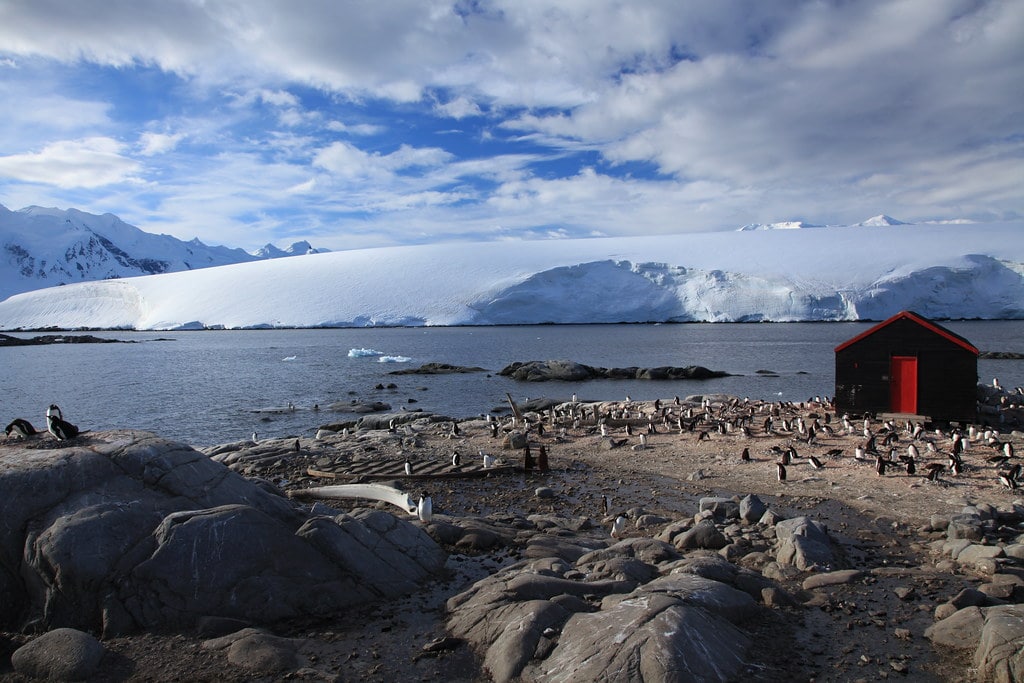
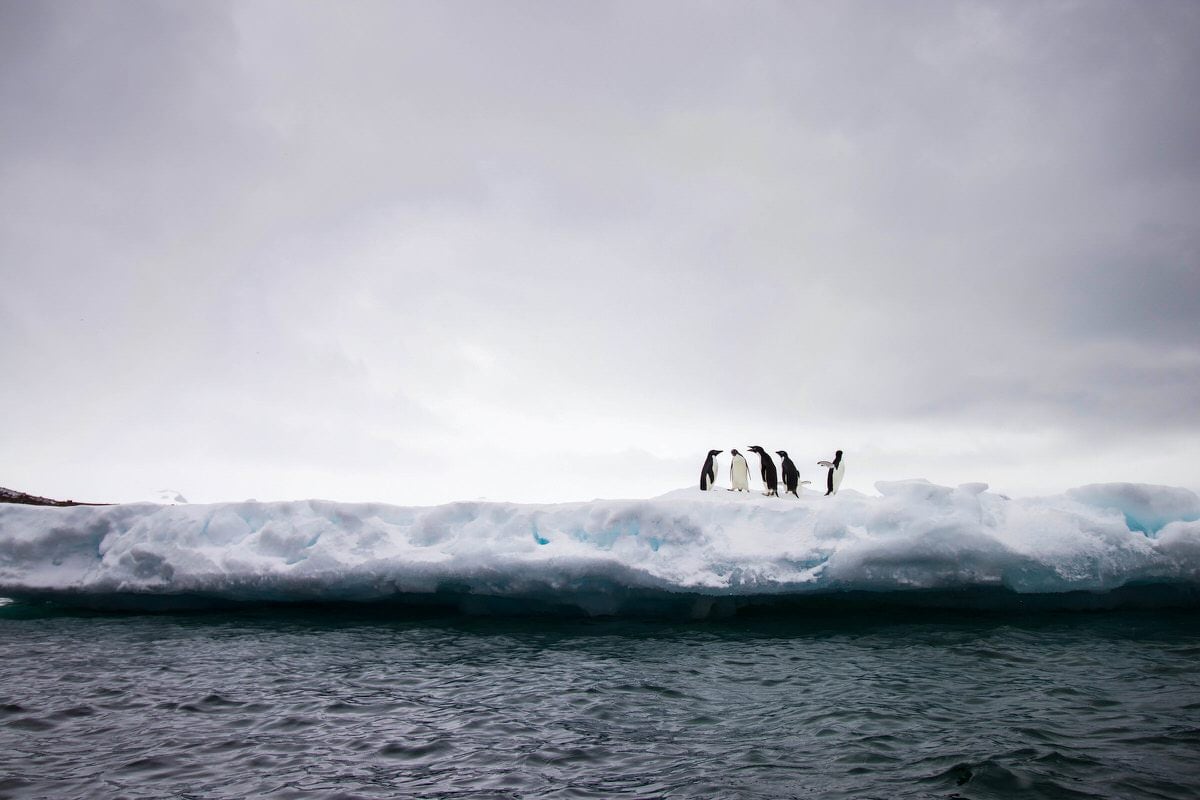
November is the season’s opening move, and it has a quality that the busier months can’t replicate: genuine stillness. The sea ice is still partially intact, meaning some areas are inaccessible — but the areas you can reach feel untouched in a way that’s hard to articulate. Very few ships have sailed through yet. Penguin rookeries are being established; the birds are present, paired up, and actively nesting. There’s a baseline absurdity to watching a colony of Adélie penguins argue over pebbles while you’re standing in front of a glacier larger than most European countries.
For photography, November offers something the other months don’t: low-angle light. The sun circles the horizon at a shallow arc, casting long golden raking light across the ice for hours at a time — not the brief golden hour you manage to squeeze in during a shoot back home, but something more like a sustained, hours-long glow that turns every surface into a mirror. For an elopement shoot, this is extraordinary to work in.
This is Antarctica at full volume. Penguin chicks have hatched and are everywhere — sprawling, demanding, completely indifferent to your presence. Humpback and minke whales are feeding actively in the bays around the peninsula. The sea ice has retreated enough that ships can access a wider range of landing sites, and the wildlife density on any given shore excursion is at its peak. If you want the postcard version of Antarctica — teeming with life, endlessly chaotic in the best possible way — this is it.
December and January also bring the midnight sun. The sun doesn’t set. It dips toward the horizon somewhere between 11pm and 2am, turns the sky shades of pink and amber that have no real equivalent at lower latitudes, and then rises again without ever actually disappearing. For an elopement, this means you’re not working against a clock. The “best light” isn’t a 20-minute window at dusk — it’s a continuous ambient glow that you can plan around, return to, and linger in. I’ve photographed ceremonies at 1am in this light. There are no words for it.
The trade-off: this is peak season, which means higher demand, fewer available berths, and more ships in the water simultaneously. If you’re on a cruise, you may encounter other vessels at popular landing sites. If you’re at a fly-in camp, the camps are still small and private — but you’ll need to book 12 to 18 months out to have any choice in your dates.
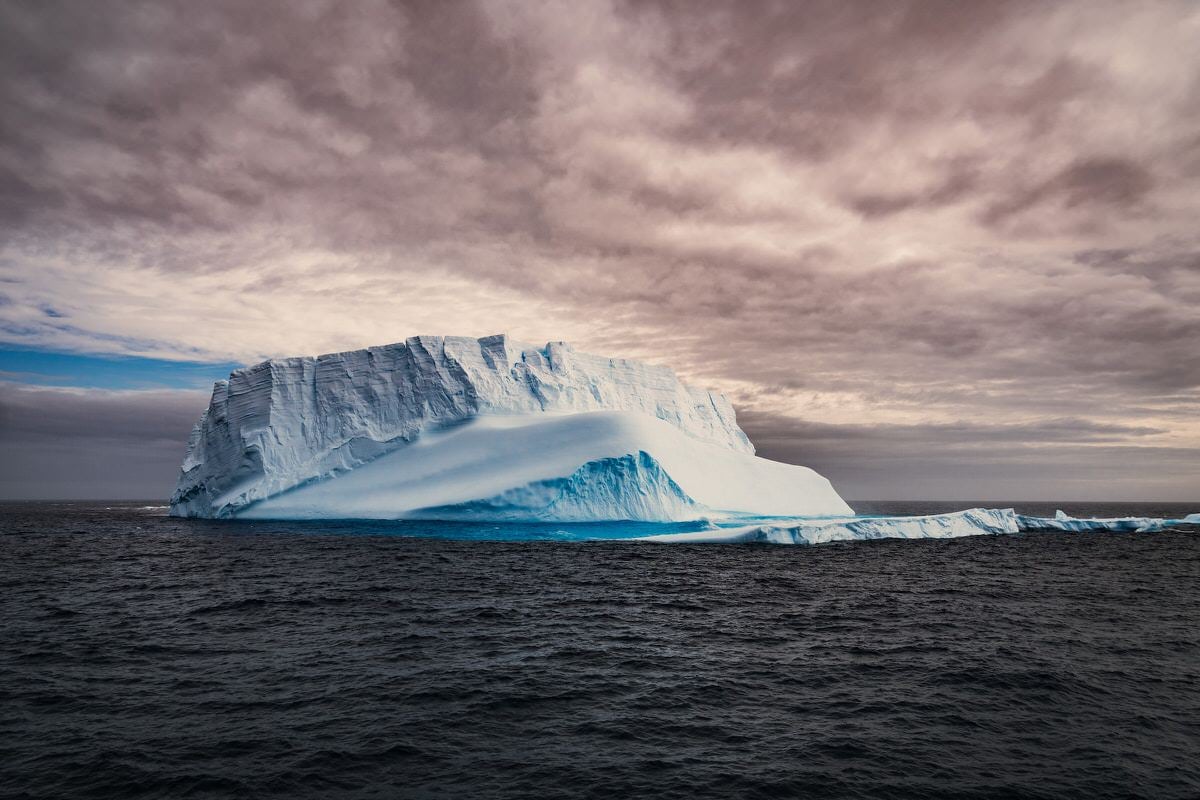
By February, the season is winding down — and Antarctica shifts into something quieter, colder, and visually different in ways I find genuinely compelling. The icebergs that calved earlier in the summer have had weeks of melt and refreezing to work on them, and the results are extraordinary: dense sculptural forms in deep electric blues and greens, weathered into shapes that no early-season ice will ever achieve. The light is also changing — the sun now sets for real, and the sky does things at dusk that it simply doesn’t bother with in December.
Penguin chicks are nearly full-grown and beginning their first tentative encounters with the water. Whale activity continues. Visitor numbers have dropped compared to peak season, and the ships that are still operating tend to be the more adventurous itineraries pushing into less-traveled areas. February and March are not the backup choice — they’re the right choice for a specific aesthetic, and for couples who want the feeling of being at the very end of something.
The midnight sun of December, the sculptural blue ice of February, the raking gold of November — these aren’t the same destination. They’re three different versions of Antarctica. Which one is yours depends entirely on what you’re going there for.
Antarctica has weather. Real weather — not the kind you check an app for and plan around, but the kind that grounds flights, holds ships in port, and turns a clear horizon into a whiteout in forty minutes. Every operator who’s been running expeditions here for more than a season has stories. Every experienced traveler who’s been here has a day they spent waiting rather than moving.
This is not a flaw in the destination. It’s a feature of it, and it’s one of the reasons Antarctica attracts the kind of traveler it does. But it has direct implications for how you plan an elopement: no ceremony can be scheduled to the hour. No flight to the interior can be guaranteed on a specific day. No landing site is locked in until the ship’s expedition team assesses conditions on the morning. You build buffer time into your trip — minimum two days either end for fly-in expeditions, and a realistic mindset for cruises. The ceremony will happen. It just won’t happen on a schedule that a wedding planner’s spreadsheet can hold.
One final note on timing that most guides skip over: the interior fly-in camps — White Desert’s Whichaway and Echo, and ALE’s Union Glacier and Three Glaciers Retreat — operate on an even narrower window than the cruise season. Most are open from late November through early January. If those experiences are calling to you, the calendar is non-negotiable, and the booking lead time is longer than for anything else on this list. Start planning earlier than feels necessary. In Antarctica, it always is.
The season fills fast
The best berths
and camp dates are gone
12–18 months out.
If you have a season in mind, the time to start is now — not when it feels urgent. I help couples navigate operator selection, date availability, and logistics from the first conversation. The earlier we talk, the more choices you have.
Let’s lock in your seasonNo commitment. Just a conversation about whether Antarctica is the right fit for you.
Getting There
How to Get to Antarctica:
The Two Paths
Most destination guides treat Antarctica as a single experience with a single access route. It isn’t. There are two fundamentally different ways to get there, and which one you choose shapes everything: the landscape you’ll see, the length of your expedition, your level of privacy, your budget, and what your ceremony will actually look like. Getting this decision right is the most important planning call you’ll make — before you think about dates, outfits, or anything else.
The first path is the expedition cruise, departing from the southern tip of South America and crossing the Drake Passage into the Antarctic Peninsula. The second is a fly-in expedition to the interior of the continent — reached by charter jet from Cape Town or Punta Arenas, landing on glacial ice runways far beyond what any ship can access. These are not variations of the same experience. They are different Antarcticas.
The vast majority of Antarctica expeditions begin in Ushuaia, the southernmost city in the world, perched at the bottom of Argentine Patagonia. A handful depart from Puerto Williams, just across the Beagle Channel in Chile — slightly further south, slightly more remote, same principle. From either port, expedition ships head east and then south, crossing the Drake Passage and arriving at the Antarctic Peninsula after roughly two days at sea. The return crossing adds another two days. Your total trip runs anywhere from ten days for the most focused itineraries to three weeks for routes that include South Georgia and the Falkland Islands.
For an elopement, the cruise model has a distinct quality: you’re moving. New landing sites every day or two, new landscapes, new wildlife encounters. The ceremony happens at one of those landings — on shore, on ice, with whatever the continent decides to give you that morning. It’s not repeatable, and it’s not staged. That’s what makes it work.
The Drake Passage — An Honest Assessment
The Drake Passage is the body of water between Cape Horn and the South Shetland Islands — roughly 800 kilometers of open ocean where the Pacific, Atlantic, and Southern Oceans converge with nothing in the way. It is, by most measures, the roughest stretch of sea on the planet. Swells of four to six meters are standard. Eight to ten meters is not unusual. Some crossings are calm enough that people barely notice them. Others are days of involuntary furniture rearrangement and a queasy recalibration of your relationship with the horizon.
I’m telling you this not to discourage you, but because you deserve the honest version before you commit four days of your trip to it. Most expedition travelers come out the other side with a story they’re proud of. Some come out of it having decided never to do it again. If one of you has a history of serious motion sickness, the fly-the-Drake option (below) is not a compromise — it’s the smarter call.
Choosing Your Ship: What Actually Matters for an Elopement
Not all Antarctic cruise ships are the same, and the difference matters enormously if you want to set foot on the continent. The Antarctic Treaty, enforced by IAATO (the International Association of Antarctica Tour Operators), stipulates that only ships carrying fewer than 500 passengers can make landings — and only 100 people can be ashore at any one time. In practice, the ships that run serious expedition programs carry far fewer.
The gold standard for an elopement. Everyone goes ashore — no group rotation, no waiting on deck while others land. Zodiac operations are fast and flexible. Guides are expert naturalists, glaciologists, and marine biologists. These ships can access bays and coves that larger vessels can’t. The entire landing experience is built around being in the environment, not watching it from a distance. This is the category your elopement should be in.
RecommendedLandings are still possible under IAATO rules, but groups rotate — you’ll wait for your turn. The experience is more managed and less spontaneous. Some mid-size ships run excellent expedition programs; others are closer to conventional cruising with an “expedition” label. Research the operator carefully. These ships can work for an elopement, but you’ll have less flexibility in where and when you land.
Verify carefullyScenic cruising only. No landings. You’ll see Antarctica through a window or from a deck — which, to be fair, is still Antarctica. But for an elopement, the fundamental point is moot: you won’t be on the ice. These ships are not what this guide is for.
Not for elopementsThe Operators Worth Knowing
I have no commercial relationship with any of these companies. This is an honest assessment of the operators I’d consider recommending based on reputation, expedition depth, and specific relevance to an elopement context.
Purpose-built for expedition travel, Ultramarine carries two Airbus helicopters and 20 Zodiacs, enabling a level of access and flexibility that very few ships match. Quark also offers the fly-the-Drake option — Punta Arenas to King George Island by plane, then boarding the ship in Antarctica — which eliminates four days of Drake crossing entirely. If one of you is Drake-averse, this is the operator to call first.
114 passengers, and — critically for an elopement — everyone goes ashore at the same time. No rotation, no groups, no waiting. Poseidon averages 2.5 hours of time ashore per day, which is among the highest in the industry. The smaller guest count means landings feel genuinely private, and the ship can access sites that larger vessels never reach. If maximum time on the ice with minimum crowd is your priority, this is the option I’d look at hardest.
Aurora’s X-Bow hull design — a sloping forward hull that cuts through waves rather than slamming against them — makes the Drake crossing meaningfully more comfortable than most ships. Their expedition team is regarded as one of the strongest in the industry. The Douglas Mawson, launched in late 2025, also opens East Antarctica itineraries from Australia and New Zealand for couples based in the Pacific region.
Ponant’s Charcot is the only luxury vessel capable of breaking through pack ice to reach the Weddell Sea and the High Arctic — areas that are simply inaccessible to conventional expedition ships. If you want Antarctica off the standard tourist route, the Charcot is the only ship that can take you there in comfort. 245 passengers means group rotation for landings, so verify the expedition program carefully — but the destinations it unlocks are like nothing else in the cruise fleet.
HX (formerly Hurtigruten Expeditions) pioneered electric-hybrid propulsion in polar cruising — the Amundsen and Nansen can run silently on battery power in sensitive areas, including near penguin rookeries and calving glaciers. That operational silence translates into wildlife encounters that feel categorically different from a diesel engine chugging alongside. Well-regarded expedition team, solid mid-range pricing.
Silversea is the ultra-luxury benchmark: butler-serviced suites, door-to-door transfers, sommelier-selected wine list, and an expedition program that doesn’t compromise the level of access just because the sheets are Italian. Also offers fly-the-Drake on certain departures. If the combination of Antarctic wilderness and five-star hospitality is what you’re after, Silversea is the clearest option in the market.
Scenic Eclipse II departs from Australia and New Zealand for East Antarctica — the route that follows in the footsteps of Mawson and Shackleton rather than the well-traveled Peninsula circuit. For couples based in the Asia-Pacific region, or for those who want the road genuinely less taken, this is a distinct alternative to the Ushuaia-departure norm. Ultra-luxury standard throughout.
What Cruises Cost: Honest Numbers
per person
10–12 days, Antarctic Peninsula. Solid expedition ship, good guides, no frills. Poseidon Expeditions, some HX departures.
per person
10–15 days. Quark Ultramarine, Aurora, Ponant Charcot. Helicopter access, premium cabins, extended itineraries.
per person
15–21 days including South Georgia & Falklands. Silversea, Scenic Eclipse II. Butler service, all-inclusive, private transfers.
Several operators — Quark and Silversea most notably — offer a hybrid approach: fly from Punta Arenas to King George Island (roughly two hours), board the ship in Antarctica, and skip the Drake Passage entirely on one or both directions. You lose two to four days of sea crossing and gain two to four days of actual Antarctica time. The surcharge is typically $1,000–$3,000 per person. If seasickness is a concern for either of you, this is not a luxury add-on — it’s the version of the trip that makes sense.
This is where most guides stop — and where this one doesn’t. The Antarctic Peninsula, reached by cruise from Ushuaia, represents perhaps five percent of the continent. The other ninety-five percent is the interior: a polar plateau of ice up to four kilometers thick, surrounded by mountain ranges, crossed by glaciers the size of small countries, and accessible only by air. No ship goes there. Very few humans ever stand on it.
Two operators run fly-in expeditions to the Antarctic interior for civilian guests. Both require arriving at a gateway city well in advance, both operate exclusively during the narrow austral summer window, and both offer something that no expedition cruise can: genuine, near-absolute privacy in the deepest interior of the coldest continent on Earth.
The interior of Antarctica isn’t a more extreme version of the peninsula. It’s a different planet. The silence is a physical thing. The scale removes all reference points. You don’t feel small — you feel recalibrated.
White Desert was founded by polar explorers Robyn and Patrick Woodhead — people who crossed Antarctica on foot before they opened it to guests. That background matters: this is not a travel company that decided Antarctica would make a good product. It’s a company built by people who love the continent deeply and have designed an experience around that. They operate two camps — Whichaway and Echo — in the Queen Maud Land region of East Antarctica, reached by A340 or private Gulfstream 550 jet from Cape Town.
The flight is five to six hours. Landing is on Wolf’s Fang Runway, a compacted ice strip in the Drygalski Mountains. From there, guests transfer to a Basler DC-3 on skis for the final leg to camp. White Desert is the only civilian operator with access to the Geographic South Pole, the emperor penguin colony at Atka Bay, and the ice tunnels beneath the plateau — all on the same trip, for those who want it all.
The Geographic South Pole. Fewer than 500,000 humans have ever stood here.
Antarctic Logistics & Expeditions (ALE) has been operating in the Antarctic interior since 1985 — longer than any other civilian operator. Their main camp at Union Glacier sits at 79°S in the Ellsworth Mountains, 1,100 kilometers from the South Pole, reached by Boeing 757-200 charter jet in four hours and fifteen minutes from Punta Arenas. The camp operates as a full-service expedition base: up to 70 guests in naturally-heated clam-shell tents, communal dining, a camp doctor, Starlink internet in shared areas, and a logistics infrastructure that supports everything from recreational snow-machining to technical mountaineering on Mount Vinson.
For couples who want more privacy than the main camp offers, ALE operates Three Glaciers Retreat: eight suites (three king, five twin) nestled at the head of three converging glaciers in the Heritage Range, a fifteen-minute flight from Union Glacier. Maximum sixteen guests, private chef, hot showers melted from glacier snow, and a setting so remote that it can be booked exclusively by a single group. It is the most private accommodation that exists anywhere in Antarctica — full stop.
One thing worth naming directly: neither Union Glacier nor anything in the ALE or White Desert footprint falls within the British Antarctic Territory. This means the legal marriage framework that applies to the Peninsula doesn’t apply here. Ceremonies in the interior are symbolic. For most couples who choose this route, that’s completely fine — the Geographic South Pole, or a glacier in the Ellsworth Mountains, or the edge of an emperor penguin colony is not a location that needs a government stamp to feel real. But if legal recognition in Antarctica is important to you, the interior fly-in and the BAT marriage are mutually exclusive, and you need to choose.
Cruise or fly-in — let’s figure it out
Two paths.
One very specific decision.
I know both well.
I’ve worked with operators on both routes, in both gateway cities, across multiple seasons. Which path is right for you depends on your budget, your tolerance for the Drake, how much privacy you want, and whether a legal ceremony in Antarctica matters. Let’s talk through it.
Help me choose my routeNo commitment. Just a conversation about what actually makes sense for you.
Accommodation
Where to Stay in Antarctica:
Every Option, Honestly Ranked
Antarctica has no hotels in any conventional sense. What it has is a small, carefully controlled set of camps and ships — each one the result of significant logistical effort and environmental compliance, each one operating within IAATO guidelines, and each one removed from everything else on the planet by several thousand kilometers of ocean or ice. The range runs from a shared expedition cabin on an ice-class ship at $8,000 per person to an exclusive private camp with a personal chef at over $100,000. They are not the same experience. Here is what each one actually offers.
← Scroll to see full table →
| Option | Operator | Access | Price /person | Per day (approx.) | Capacity | Type |
|---|---|---|---|---|---|---|
| Expedition cruise cabin | Quark, Aurora, Poseidon… | Ushuaia or fly-the-Drake | $8,000–$50,000 | ~$700–$4,000 | 100–200 guests | Cruise |
| Ultra-luxury cruise suite | Silversea, Ponant, Scenic | Ushuaia, Cape Town, Hobart | $30,000–$80,000+ | ~$2,500–$6,500 | 100–245 guests | Cruise |
| Union Glacier Camp | ALE | Punta Arenas → Boeing 757 | ~$35,000 (4 days) | ~$8,750 | Up to 70 guests | Fly-in |
| Three Glaciers Retreat | ALE | Union Glacier + 15-min flight | On application | — | 16 guests max | Remote luxury |
| Whichaway Camp | White Desert | Cape Town → A340 / Gulfstream | From ~$71,500 (6 days) | ~$11,900 | ~12 guests | Remote luxury |
| Echo Camp | White Desert | Cape Town → A340 / Gulfstream | From ~$71,500 (6 days) | ~$11,900 | ~12 guests | Remote luxury |
| Gould Bay Camp | ALE | Union Glacier + Twin Otter | Supplement on Union Glacier | — | Small group | Deep field |
| South Pole Overnight | ALE | Union Glacier + Twin Otter | On application | — | Very limited | Deep field |
On the Water:
Expedition & Luxury Cruise Cabins
The expedition cruise cabin is the entry point for Antarctic travel done properly — and done properly means an ice-class ship under 200 passengers, with a full expedition team, Zodiac landing operations, and daily time on shore. Cabins range from compact inner berths with a porthole to generous outer cabins with picture windows. The experience is built around what happens outside the cabin, not in it: landings, wildlife encounters, lectures in the evenings, and the particular intimacy of sharing a small ship through one of the world’s most extraordinary environments.
For an elopement, the cruise cabin model means your ceremony takes place on one of those landings — timed by the expedition team around conditions, wildlife, and light. You’re never more than a Zodiac ride from shore. Poseidon’s Sea Spirit is worth singling out here: 114 guests, all going ashore simultaneously, averaging 2.5 hours of time on the ice per day. For a couple who want maximum Antarctic contact with minimum crowd, this is the starting point.
Silversea’s Silver Endeavour and Ponant’s Le Commandant Charcot represent the upper end of what cruise accommodation in Antarctica looks like: butler-serviced suites, sommelier-curated wine lists, private verandas, and expedition programs that don’t compromise the environmental access in exchange for the thread count. These ships also open itineraries unavailable to standard expedition vessels — the Charcot’s icebreaker hull unlocks the Weddell Sea, while Scenic Eclipse II departs from Hobart for East Antarctica’s Ross Sea and subantarctic islands.
Silversea also offers the fly-the-Drake option on certain departures, which means you can have the ultra-luxury ship experience without the Drake Passage crossing. For couples where comfort and privacy on the ship itself matter as much as the landing experience, this category is the right one — and the itinerary extensions (South Georgia, Falklands) add a richness to the expedition that shorter peninsula-only voyages simply can’t match.
On the Ice:
Interior Fly-In Camps
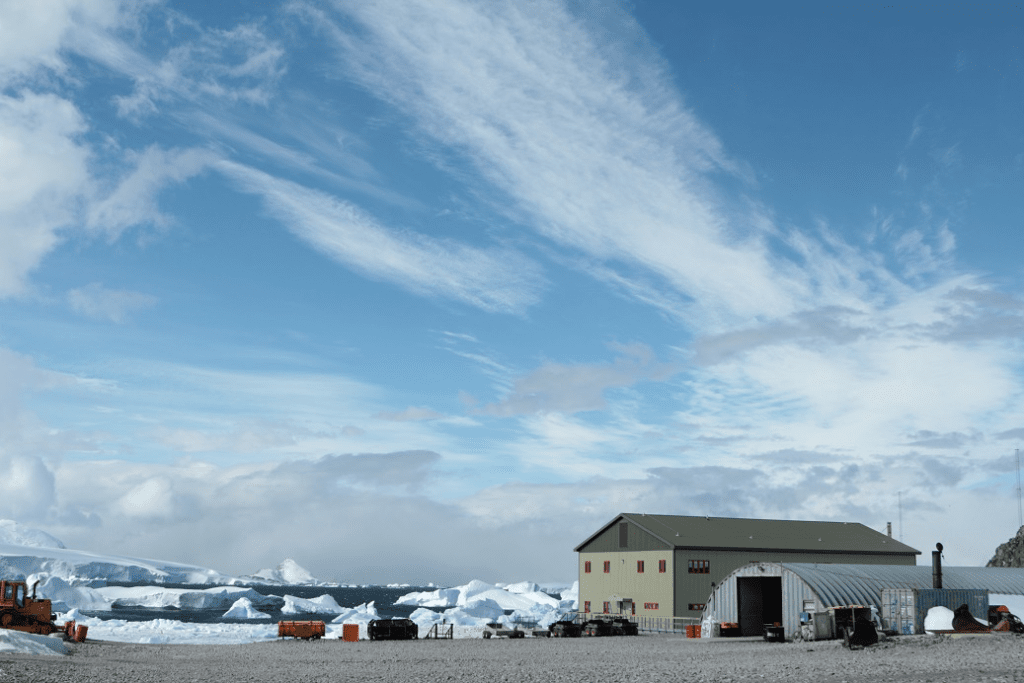
Union Glacier is ALE‘s main base in the Antarctic interior — the only civilian camp of its kind in the continent’s interior, operating since 1985. It sits at 79°S in the Ellsworth Mountains, roughly 1,100 kilometers from the South Pole, at an elevation of 700 meters. Access is by Boeing 757-200 charter from Punta Arenas in approximately four hours and fifteen minutes, landing on a naturally occurring blue-ice runway. From the runway, guests transfer eight kilometers to camp by tracked vehicle.
Accommodation is in double-walled clam-shell tents, naturally heated to 15–21°C by 24-hour sunlight. They’re comfortable, well-insulated, and designed to the specifications of Shackleton-era polar exploration rather than glamping — which is entirely the point. Communal dining tent, a camp library, Starlink internet in shared areas, and a full-time camp doctor. Union Glacier is the hub from which all deeper interior expeditions depart: Twin Otters on skis fly guests to the South Pole, to Mount Vinson, and to the emperor penguin colony at Gould Bay.
Three Glaciers is what happens when ALE decided that Union Glacier needed a quieter, more private counterpart. Located at the head of three converging glaciers — Schneider, Schanz, and Driscoll — in the Heritage Range of the Ellsworth Mountains, it sits a fifteen-minute Twin Otter flight from Union Glacier and as far from the rest of the world as it’s possible to be. Eight suites. Maximum sixteen guests. A private chef flying in ingredients from Chile. Hot showers generated by melting glacier snow. Individual Toyostove heaters. A lounge and dining suite that wouldn’t feel out of place in a remote lodge in Patagonia, except that outside the window is a view that no Patagonian lodge will ever have.
Three Glaciers can be booked as an upgrade to an existing ALE expedition, or reserved exclusively by a single group. For a couple who want Antarctica with no one else around at all — not twelve other guests, not a rotation of expedition crew, just the two of you and the guides — the exclusive buyout is the option that delivers that completely. Pricing is on application and varies with dates and group size; budget significantly above the Union Glacier base rate.
Whichaway is White Desert‘s flagship camp and the most visited of their two properties — which still means fewer than 100 guests per entire season. Six heated polar pods, each with a glass-fronted conservatory and en-suite shower (a rarity at this latitude). A communal dining pod serving three-course meals made with fresh produce, gourmet ingredients, and — memorably — cocktails mixed with 10,000-year-old glacial ice. The setting is the Schirmacher Oasis in Queen Maud Land, a rare ice-free rocky plateau surrounded by glaciers.
Whichaway is the base for White Desert’s broadest range of activities: fat-biking, ice climbing, abseiling into ice tunnels, guided hikes, skiing, and the options that no other camp can offer — flights to the emperor penguin colony at Atka Bay, and the trip to the Geographic South Pole. White Desert has been certified carbon neutral since 2007. Guests arrive via A340 or Gulfstream 550 from Cape Town, with a pre-departure safety briefing at White Desert’s Cape Town office on Loop Street.
Echo Camp is White Desert’s second property and their more minimal, design-forward option. Placed directly on the polar plateau rather than in the Schirmacher Oasis, Echo offers an uninterrupted 360-degree view of pure ice in every direction — no rock, no variation, nothing but white extending to the horizon. The camp’s architecture reflects that aesthetic: clean lines, a more pared-back interior, the same quality of food and guiding as Whichaway but in a setting that prioritizes the landscape over the comfort of familiarity.
Some couples split their White Desert stay between both camps — Whichaway for the wildlife and activity access, Echo for the experience of complete polar immersion. The “Best of Both” option is worth asking about. For an elopement shoot, the Echo plateau offers something Whichaway can’t: an absolute absence of visual reference points, a sky that dominates the frame entirely, and a light quality that shifts constantly as the sun circles the horizon.
The Furthest Points:
Deep Field Camps
Gould Bay Camp exists for one reason: emperor penguins. The colony at Gould Bay is one of the most accessible emperor penguin colonies in Antarctica — accessible being entirely relative, because reaching it still requires flying by Twin Otter from Union Glacier to a temporary field camp on the Weddell Sea coast. What waits on arrival is a colony of several thousand emperor penguins who have never been hunted, have no reason to fear humans, and will approach to within touching distance (which you won’t do, per Antarctic Treaty protocol, but the proximity is breathtaking regardless).
Accommodation at Gould Bay is a simple, insulated field camp — functional rather than comfortable, in the tradition of actual polar expedition rather than expedition tourism. This is not a luxury option. It is, however, one of the most extraordinary wildlife encounters available to any human being, and for an elopement photographer it represents a setting that no studio or destination on Earth can replicate. The camp is added as a supplement to a Union Glacier base package.
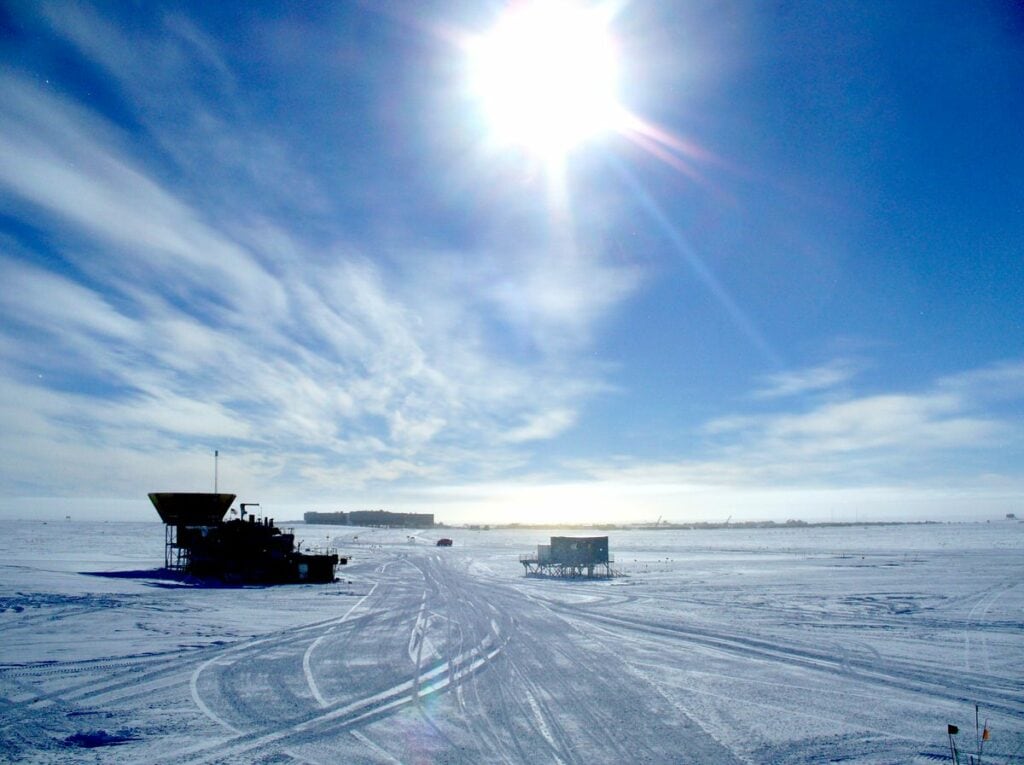
This is the end of the list because it is, in every literal sense, the end of the world. The Geographic South Pole sits at 90°S, at an elevation of 2,835 meters above sea level, on 2.7 kilometers of ice. The Amundsen-Scott South Pole Station — a United States research facility — operates here year-round, and civilian visitors are permitted access to the ceremonial and geographic poles on the exterior. What ALE offers beyond a day visit is the thing very few humans have ever done: an overnight stay at the Pole itself, in a field camp set up specifically for that purpose.
Availability is extremely limited. Pricing is on application and will be significant. The experience of watching the sun circle the horizon at 90°S — never rising, never setting, just moving in a perfect flat circle — is something that no photograph and no description will ever fully convey. For the right couple, this is not an indulgence. It is the only place on Earth where every direction is north.
Not sure which option is right for you
From $8,000 to
well over $100,000.
I’ll help you find yours.
The right accommodation depends on budget, privacy needs, how much time you have, and whether you want wildlife, mountains, the South Pole, or all of the above. I’ve worked with couples across this full range. Let’s find the option that fits your expedition — not just your budget.
Find the right fit for usNo commitment. Just a conversation about what actually makes sense for you.
Legal Framework
The Legal Reality of
Getting Married in Antarctica
This is the section most guides either skip over or get wrong. The legal status of a marriage in Antarctica is not a minor administrative detail — it determines which part of the continent you can access for a ceremony, which operator you need to book, and what paperwork you’ll be filing months before you travel. It also contains one of the most persistent myths in Antarctic travel, which I’ll address directly. Read this before you make any booking decisions.
The western coast and surrounding islands, including all standard expedition cruise landing sites. Governed under UK law, mirroring England & Wales.
Legal marriage possibleALE’s Union Glacier, Three Glaciers Retreat, Gould Bay, South Pole. White Desert’s Whichaway and Echo. No established legal marriage framework.
Symbolic ceremonies onlyNo paperwork. No jurisdiction. No filing deadlines. A symbolic ceremony means you exchange vows on the ice — on a Zodiac landing, at the edge of a glacier, at the Geographic South Pole, wherever the expedition takes you — and the moment is exactly as real as you need it to be, without any legal machinery attached to it.
This is the option chosen by the majority of couples who elope in Antarctica, and not as a second-best choice. Many couples have already registered their marriage civilly at home — or plan to after the trip — and treat the ceremony on the ice as the actual event: the moment that means something, free from the administrative requirements of governments that have no presence here. It’s also the only option available for fly-in interior expeditions, which take you outside the British Antarctic Territory entirely.
There is no officiant requirement. No witness requirement. No form to file. You can write your own vows, choose your own moment, and have a photographer — ideally one who has thought carefully about polar light conditions — document it properly. The freedom this gives you in terms of location, timing, and atmosphere is significant.
British Antarctic Territory
The Antarctic Peninsula falls under the jurisdiction of the British Antarctic Territory, a UK Overseas Territory administered by the Foreign, Commonwealth & Development Office. Marriage law in the BAT mirrors that of England and Wales — which means all couples, including same-sex partners, can legally marry there. It also means the process is governed by UK legal requirements, and those requirements are specific.
The official resource for everything that follows is the BAT Getting Married page — bookmark it, read it in full, and use it as your authoritative source alongside the information here.
Confirm your operator has a BAT-registered Marriage Officer. This is the first call you make — before dates, before berths, before anything. Not every expedition ship carries a certified BAT Marriage Officer. Ask directly and get written confirmation.
Contact the BAT Administration at least three months before your ceremony date. The contact is [email protected]. They will provide the required notice of marriage form and guide you through the process. Do not leave this until six weeks out — the timeline is firm.
Submit your notice of marriage and supporting documents. Both parties will need to provide proof of identity, proof of single status, and any divorce or death certificates if previously married. The BAT Administration will confirm what is required for your nationalities specifically.
Pay the license fee: £500. This covers the registration and the issuing of your marriage certificate. Payment details are provided by the BAT Administration on application.
Your ceremony is officiated by the BAT Marriage Officer onboard or ashore. The Marriage Officer signs and registers the marriage. You receive a UK-issued marriage certificate, valid under British law.
Non-UK nationals: verify recognition in your home country. The UK certificate is legally valid in the UK. Recognition in other countries varies — see country notes below.
The ship captain cannot marry you. This is one of the most widespread misconceptions in Antarctic travel, and it appears regularly in otherwise well-researched articles. A ship’s captain has no authority to perform a legally binding marriage in any jurisdiction, including the BAT, unless they are specifically registered as a BAT Marriage Officer. Some guides and expedition staff hold this certification — captains generally do not. If any operator tells you otherwise, verify independently with the BAT Administration before you proceed.
Fully recognized. Your BAT marriage certificate is a standard UK marriage document.
Requires transcription at the French state civil registry (état civil). Standard procedure for any marriage celebrated abroad — your notaire or mairie can guide you on return.
Varies by country. Most nations recognize marriages legally performed abroad. Verify with your consulate or a local civil lawyer before the trip, not after.
Outside Any Legal Framework
Union Glacier, Three Glaciers Retreat, Whichaway Camp, Echo Camp, Gould Bay, the Geographic South Pole — none of these fall within the British Antarctic Territory. The BAT covers the Peninsula and the surrounding islands. The continental interior has no established civilian legal framework for marriage at all.
This means one thing practically: ceremonies in the interior are symbolic. There is no application process, no Marriage Officer requirement, and no certificate issued. What you gain in exchange is complete freedom — freedom of location, of timing, of format, of everything. The South Pole is not a BAT site. You cannot legally marry there. You can, however, stand at 90°S and say whatever you want to say to each other, with a photographer who has planned carefully for −30°C and two hours of continuous golden light. For most couples who choose the interior, that is more than enough.
If legal recognition matters to you and the interior is where you want to be, the solution is clean: register your marriage civilly at home before the expedition, or immediately after returning. The civil registration becomes the legal event; the ceremony at Union Glacier or the South Pole becomes the real one. Many couples find this arrangement more honest, not less.
The legal question and the meaningful question are not the same question. Most couples who elope in Antarctica have already answered the meaningful one long before they file any paperwork.
A Practical Summary:
Before You Book Anything
To avoid any ambiguity, here is the decision tree in plain language. If a legally binding ceremony in Antarctica is important to you: you need an expedition cruise to the Antarctic Peninsula, you need to confirm your chosen operator has a BAT-certified Marriage Officer before you pay a deposit, and you need to contact [email protected] at least three months before your ceremony date. That is the complete list of requirements. Everything else — the ceremony format, the vows, the location on shore — is yours to decide.
If a symbolic ceremony is right for you, or if you’re planning a fly-in interior expedition: none of the above applies. Book the expedition that fits your priorities, plan the ceremony around the best conditions on the day, and verify recognition in your home country if you’re registering your marriage separately. The official BAT marriage guidance is the authoritative source for any questions the BAT route raises — I’d always direct you there over anything you read on a wedding blog, including this one.
The paperwork is manageable. The planning is not.
Legal or symbolic —
I’ve navigated both.
Let’s sort yours.
Between BAT filing timelines, operator verification, and coordinating the ceremony around Antarctic weather and wildlife, the logistics of an Antarctica elopement are genuinely complex. That’s exactly what I’m here for. One conversation covers the legal question, the operator question, and everything else.
Let’s sort the detailsNo commitment. Just a conversation about what actually makes sense for you.
Getting Dressed
What to Wear —
And What Actually Works at −20°C
I’ve been photographing in extreme cold since 2013. In that time I’ve watched more than a few carefully planned outfits fight losing battles with wind, ice, and temperatures that turn silk into a stiff, unhappy fabric and heels into a liability. Antarctica is not hostile to looking good. It is, however, completely indifferent to the fact that you tried.
What follows is not a shopping list. It’s what I’ve learned from being outside in these conditions — as a photographer, as someone who has stood on ice in varying states of appropriate and inappropriate preparation, and as the person who has to tell a couple, gently, that their original plan won’t work.
The core principle is simple: you dress for the cold first, and build the ceremony outfit over it. Antarctica doesn’t make exceptions for aesthetics. The good news is that the most photographically striking elopement looks I’ve ever shot in polar conditions weren’t despite the layers — they were because of them.
The Foundation:
The Layering System
Every polar guide, expedition team, and cold-weather photographer works from the same foundational principle: three layers, each doing a specific job. The ceremony outfit — whatever it is — sits on top of this system, not instead of it. You will be outside for 20 to 30 minutes for the ceremony itself, and potentially hours more for the expedition. The layering system is what makes both possible.
Merino wool or a technical synthetic. Its job is to move moisture away from your skin and keep a thin layer of warmth directly against your body. Cotton does the opposite — it holds moisture and makes you colder. Nothing cotton touches your skin in Antarctica. This is the one rule with no exceptions.
For a ceremony, a fitted merino base layer is also the easiest thing to style over: it creates a smooth, slim foundation that a dress or shirt can sit cleanly on top of without bulking. Merino is also odor-resistant, which matters when you’re wearing the same base layer for several days in a field camp.
A fleece or down jacket. This is where the warmth is generated and retained. Down is lighter and compresses better (useful if you’re carrying it in a pack between landings). Fleece is more resilient in damp conditions. Either works. What matters is that it fits close enough that the outer shell can go over it without restricting movement, and that it covers your torso fully — no cropped anything here.
For the ceremony, the mid layer is usually what you remove (briefly) if you want the dress to read clearly in photos. You build the shot around the window when your outer shell is off and the dress is visible — typically two to four minutes maximum before the cold becomes uncomfortable. I time these moments carefully.
A hardshell or softshell jacket and waterproof salopettes (overtrousers). The shell’s job is to stop wind and precipitation from penetrating the system underneath. It doesn’t need to be warm on its own — that’s the mid layer’s job. It needs to be windproof, waterproof, and have enough mobility that you can board a Zodiac, step onto uneven ice, and move freely.
Most cruise operators provide outer layers if you don’t own them — parkas and rubber boots are standard issue. Fly-in camps provide full gear lists and often loan or rent what you’re missing. Ask your operator directly. You don’t need to buy a $600 hardshell for one expedition if you can borrow one.
The Ceremony Outfit:
What Actually Photographs Well in Polar Conditions
The ceremony outfit isn’t instead of the layering system — it’s on top of it, or around it. Here’s how the main options play out in practice.
A dress in chiffon, georgette, or another lightweight material that moves well in wind is the most reliably photogenic option. The movement is the thing — Antarctic wind creates constant gentle motion in lighter fabrics that photographs beautifully, giving the images a life that heavier fabrics can’t replicate. Keep it simple: a clean silhouette reads better against an ice backdrop than anything embellished. Over base and mid layers, a dress in these materials looks entirely intentional rather than cold.
Avoid: silk and satin (freeze in the cold, wrinkle on contact with any moisture, and transmit cold directly), heavily structured bodices (restrict movement and sit awkwardly over thermals), and anything with a long train (it will be wet within thirty seconds).
RecommendedI’ve seen veils in Antarctica exactly once. It did not go well. Antarctic wind is not the predictable gentle breeze of a beach wedding — it shifts direction, gusts without warning, and has no interest in your veil staying in frame or in place. A veil becomes a sail, then a liability, then a photographic problem I’m trying to solve in real time instead of focusing on you.
The replacement is simple and often more striking: a loosely worn hood from your outer shell, or nothing at all. Hair loose or loosely braided holds better than anything pinned, and moves in wind in a way that’s genuinely more beautiful than a veil in these conditions. Trust the landscape. It’s doing enough.
Skip itThis is what I recommend most often for Antarctica, and the couples who’ve done it have never regretted it. A flowing cape or wide-cut coat in white, ivory, or cream worn over a full polar kit creates an image that is specifically, unmistakably polar — it plays with the landscape rather than fighting it. The coat or cape reads as ceremony; everything underneath reads as expedition. The combination is the point.
Practically: a cape has no sleeves to interfere with gloves and no fitted waist to fight with salopettes. A wide-cut coat in a natural fibre like wool or cashmere will actually provide additional warmth rather than fighting the cold. This is the option that produces the most iconic images I’ve made in polar conditions.
Most recommendedThe same layering system applies. On top of thermals and a mid layer, a well-fitted wool coat, a structured shirt visible at the collar, or simply clean expedition gear with intention reads completely well against ice. The key is fit — clothes that are slightly too large or slightly too small show immediately in the clean, high-contrast Antarctic light. Fit matters more here than anywhere else I’ve shot.
Dark colours photograph beautifully against white ice. Navy, charcoal, and black all work. Bright accent colours — a red scarf, an orange beanie — add a point of warmth to otherwise monochromatic images. These choices aren’t accidental; we plan them in the brief before arrival.
Planned intentionallyThe Details That
Actually Matter
For fly-in camps and ceremony moments away from water, insulated waterproof boots with crampons are the standard. Many operators loan microspikes or crampons; confirm in advance. If you want the dress to be visible at ground level, high boots with wool socks are the most photographically honest version of Antarctica footwear — and they look exactly right for what this expedition is.
The Layer System, Hands Edition
Touchscreen fingertips are useful but not essential — most actions in Antarctica don’t require a touchscreen. What matters is that you can remove the outer mitt quickly when you need dexterity, and put it back on just as quickly. Practice this before you arrive.
Plan the ring exchange moment specifically. Rings and gloves are incompatible, which means there is a window — 60 to 90 seconds with bare or liner-gloved hands — during which the exchange happens. In my pre-shoot brief, we plan exactly when this happens and how. Remove outer mitts, exchange rings, photograph the hands against the ice, mitts back on immediately. It’s one of the most intimate moments of every Antarctica ceremony I’ve photographed, precisely because it requires deliberate intention. We don’t rush it, but we don’t dawdle either.
The dress or cape over base layers and mid layer. Outer shell temporarily removed or opened. Ceremony first, photos during. This is the 20–30 minutes of cold exposure during which the images you came for are made. We plan the light, the backdrop, the direction, the ring moment. Everything is intentional.
Duration: 20–30 minutes maximum · Outer shell off or openFull polar kit: outer shell on, boots, mitts, everything. These are the shots that show you actually went to Antarctica — in an inflatable Zodiac approaching a glacier face, on the ice with penguin colonies in the background, at 90°S with the South Pole marker behind you. These images are not less than the ceremony photos. Often, they’re the ones couples look at most.
Duration: as long as conditions allow · Full gear onThe couples who embrace the expedition gear — who stop trying to minimize the polar kit and start treating it as part of the visual — always get the best images. Antarctica doesn’t photograph against you. It photographs with you, if you let it.
The brief happens before you pack
I plan the outfits,
the light, and the timing
before we land.
Every Antarctica couple I work with gets a detailed pre-shoot brief: what to bring, what to borrow from the operator, how to layer it, when to have the outer shell off, and how long we realistically have in each condition. Nothing is improvised on the ice. The planning happens here, in advance. That’s how the images work.
Let’s plan your looksNo commitment. Just a conversation about whether Antarctica is the right fit for you.
The Day Itself
What Your Elopement Day
Actually Looks Like
No two Antarctica elopement days are the same, because no two Antarctic mornings are the same. The weather decides more than you do. The wildlife arrives on its own schedule. The light is doing something extraordinary, or it’s doing something completely different from what you expected, and both of those are the right answer. What I can give you is an honest picture of how these days tend to unfold — across the two very different contexts of a cruise landing and a fly-in interior expedition — so that you arrive knowing what to expect, and more importantly, knowing how to be in it.
Version 01 — Expedition Cruise
One Landing.
Everything Happens There.
On an expedition cruise, your ceremony doesn’t have its own day. It happens within a landing — one of the two or three shore excursions your ship makes each day of the voyage. That’s not a limitation. It’s the structure of the whole experience, and once you understand it, you can work with it rather than around it. The landing is Antarctica: the wildlife, the ice, the landscape, the sound, the cold. The ceremony is the moment you choose within that.
While you’re still asleep (or more likely awake and watching out your porthole), the expedition team is already on deck evaluating the morning: sea state, wind, ice conditions at the planned landing site, wildlife activity. They make the call on whether the landing goes ahead, and where. This assessment happens every morning, without exception.
No landing is guaranteed until the morning of. This is why you never lock in a ceremony time in advance.
The expedition leader broadcasts the day’s plan over the ship’s PA — or appears in the dining room. Landing site confirmed, timing confirmed, conditions briefed. If this is the day, this is the moment you know. I’ve already been thinking about light angles since I woke up.
The expedition team runs the landing briefing: protocol for disembarking into Zodiacs, rules on the shore (no approach within 5 meters of wildlife, no going off marked paths, no taking anything), and conditions-specific notes. You pull on your outer shell, your rubber boots, your gloves. The layering system is fully on. The dress is underneath, waiting.
Eight to twelve people per inflatable Zodiac, seated on the tubes, gear in your lap, the ship receding behind you. The ride to shore takes anywhere from three minutes to twenty, depending on the anchorage. The moment the ship disappears behind the hull angle and Antarctica fills every direction — that’s when most people go quiet. Some cry before the ceremony even starts. This is normal. This is the point.
We find the spot. I’ve already scoped the landing site from the Zodiac: the angle of the light, the position of the glacier face or penguin colony, the direction of the wind. We move away from the main group — never far, always within the designated zone — and the outer shells come off. Ceremony gear on. The ring exchange. The vows. 20 to 30 minutes of full presence, documented properly.
If a BAT Marriage Officer is involved, they join for this section specifically. The rest of the landing continues around us — we are part of the expedition, not separate from it.
Outer shells back on. Now we have the rest of the landing — typically another 90 minutes to two hours — for the expedition images: full polar kit, the wildlife that wandered close, the glacier, the expanse. These are the shots that prove you were here, fully and completely, not as tourists who happened to get dressed up, but as people who came to this place and belonged in it.
The recall signal sounds — a horn, or a radio call, depending on the ship’s protocol. Zodiacs return in groups. You climb back aboard, hand off the rubber boots, and stand on deck watching the landing site shrink as the ship moves on to the next position. The afternoon will bring another landing, or a cruise through an ice-choked channel, or a lecture from the naturalist. The day is far from over.
Most expedition ships are happy to mark the occasion — tell them in advance, and the dining team will produce something fitting. Champagne, a dedicated table, a cake that somehow survived the Drake. The ship’s staff have seen a handful of these in their careers, and they treat them accordingly. The expedition team will raise a glass. So will several strangers who were watching from a respectful distance on shore and now feel, correctly, like witnesses.
Version 02 — Fly-In Interior
Several Days.
The Ceremony Finds Its Own Moment.
The fly-in experience is structurally different in one fundamental way: you have time. Not a landing window, not 2.5 hours before the recall horn — you have four days, six days, eight days, on the ice. The ceremony can happen on day two when the light is extraordinary, or on day four when the wind finally drops, or at 1 am on the third night when the sun is grazing the horizon and the plateau is pink in every direction. This is where my role as a planner matters most. No one needs a planner for a cruise landing where the timing is decided by the expedition team. For the fly-in, I’m the one tracking the light windows, reading the forecast with the camp guide, and deciding when to go.
No advance booking, no fixed hour. We watch the weather and light across your stay and choose the window that’s right.
At White Desert and Three Glaciers Retreat especially, the guest count is low enough that the camp operates around you, not the reverse.
On foot, by snowcat, by Twin Otter. The ceremony location is not the camp itself — it’s whatever the continent offers that day.
The forecast, the camp guide’s read on conditions, the direction the light is coming from at each hour. I’ve been thinking about this since before we landed.
A typical fly-in day has a rhythm but not a schedule. Breakfast is communal, usually early, because the Antarctic morning light in November and December is worth getting up for. After breakfast, the camp guide briefings conditions and available activities. This might be a snowshoe hike to a nearby summit, a fat-bike session on the glacier, time in the ice tunnel at Whichaway, or simply walking away from the camp until the sound of it disappears and you’re alone in a silence so complete it has a texture.
The ceremony itself unfolds without a program. We walk to the location — which I’ll have scouted the day before — and we take the time that the moment takes. No recall horn. No rotation group waiting on the beach. We stay until the images are what they need to be, and then we walk back to camp for a dinner that tastes, I promise you, like the best meal you’ve ever eaten — because everything tastes better at this latitude, and because you just got married at the end of the world.
The fly-in gives you something the cruise can’t: the ceremony is the day. Not a window within the day. The whole day belongs to it.
Photography at Hours That Shouldn’t Exist
In December and January, the sun does not set in Antarctica. It circles the horizon — dipping toward it between roughly 11 pm and 2 am, turning the sky amber and pink and sometimes a colour that doesn’t have a name, and then rising again without ever having disappeared. The concept of “golden hour” as photographers use it — that brief window of warm directional light just after sunrise or before sunset — becomes something else entirely here. It becomes a sustained, hours-long state that you can plan around, return to, and choose to be inside whenever the conditions call for it.
I’ve photographed ceremonies at 1 am in this light. I’ve made images at 11:45 pm that look like they were taken during a European golden hour in September. The quality of light at the horizon-grazing point of the polar day is genuinely extraordinary: it’s warm, directional, low-angle, and completely unobstructed by any horizon feature — because Antarctica’s horizon is perfectly flat in every direction, and the sun traces it in a circle.
On a cruise, the midnight light is available during any evening on deck or on a night landing if your operator runs them. On a fly-in expedition, it’s a tool I use deliberately: if the conditions are flat during the afternoon, we wait. The midnight window is better. We go then. There is no curfew, no lights-out, no one checking whether you’ve gone to bed. Antarctica in December operates on solar time, which means it never really does.
For couples who book in December or January specifically for the midnight sun: yes, it’s worth it. It is exactly as extraordinary as you’ve imagined, and the images it produces are unlike anything you’ll make anywhere else on Earth.
The day is planned before we land
I know the light.
I know the timing.
You just have to show up.
Whether it’s a cruise landing or a six-day fly-in, the photography and planning work the same way: I track the conditions, I choose the window, I brief you the evening before, and we go when the light is right. The preparation is what makes the day feel effortless. Let’s talk about yours.
Let’s plan the dayNo commitment. Just a conversation about whether Antarctica is the right fit for you.
The Absolute Limit
Reaching the South Pole by Air —
The Ultimate “I Do” Location
There is a place where every direction is north. Where the sun circles the horizon in a flat, unbroken ring and never sets in summer. Where fewer people have stood than have orbited the Earth. It sits at the precise bottom of the planet — 90°S, 2,835 meters above sea level on nearly three kilometers of ancient, compacted ice — and it is, without qualification, the most remote elopement location on Earth.
This section is for the couples who read everything above and thought: further. Not the peninsula, not even Union Glacier. The actual Pole.
The Geographic South Pole. Every meridian converges here. Every direction from this point is north.
On top of 2.7km of ice sheet. Altitude affects everyone — acclimatization at Union Glacier before flying south is built into most itineraries.
Average in summer (Dec–Jan). Can drop to −40°C with wind chill. The coldest ceremony location accessible to civilians. Prepare accordingly.
At 90°S the sun doesn’t rise or set. It circles you. The light at midnight is the same as the light at noon — warm, low, directional, and endless. There is nowhere on Earth that photographs like this.
How You Get There:
The Only Two Routes
The South Pole is not reachable by cruise ship. There are no roads. The two operators who run civilian access — ALE and White Desert — each fly guests in on small ski-equipped aircraft from their interior bases. These are the only ways in. There is no third option.
The journey begins at home. You fly internationally to your gateway city — Punta Arenas, Chile for ALE; Cape Town, South Africa for White Desert. Build in buffer days: both cities are the mandatory holding point while the interior flight waits for a weather window.
ALE operates a Boeing 757-200 charter from Punta Arenas to Union Glacier (79°S) in approximately 4h15. White Desert flies an Airbus A340 or private Gulfstream 550 from Cape Town to Wolf’s Fang Runway in approximately 5–6 hours. Both land on compacted natural ice or snow runways — no tarmac, no terminal.
The final leg is by Twin Otter DHC-6 on skis — a small, rugged, legendary polar aircraft. From Union Glacier, the Pole is roughly 600 miles south: approximately 3 hours of flying at low altitude over the polar plateau. From White Desert’s Wolf’s Fang, access is similar. The aircraft lands on the skiway adjacent to the Amundsen-Scott South Pole Station. You step out at 90°S.
You’re here. The ceremonial pole — a striped barber’s pole surrounded by the flags of the Antarctic Treaty nations — stands a few meters from the actual geographic marker, which is repositioned each year to account for the movement of the ice sheet beneath it. The Amundsen-Scott Station is a short walk. Visitors are permitted on the exterior. The interior is a US research facility and not open for ceremonies or general access.
Symbolic, and Entirely the Right Call
The South Pole falls entirely outside the British Antarctic Territory. There is no established legal marriage framework here, no BAT Marriage Officer, no certificate issued. Any ceremony at 90°S is symbolic. That statement would matter more if the location mattered less. It doesn’t. I’ve never met a couple who stood at the Geographic South Pole and felt that the absence of a government stamp diminished what they were doing.
If legal recognition is important to you, register civilly at home before or after the expedition. The Pole ceremony is the real event — the legal registration is the administrative one. Treat them in that order, and you’ll never feel that anything is missing.
The Amundsen-Scott Station is staffed by American research scientists on rotating contracts. They’ve watched a small number of ceremonies happen just outside their facility over the years. They are, by all accounts, good witnesses — even if they’re watching from inside, through a window, with coffee.
The Two Operators
Who Can Take You There
ALE has operated at Union Glacier since 1985 and runs more South Pole logistics than any other civilian operator on the planet. From Union Glacier base, the Pole is a Twin Otter flight south. ALE offers both day visits — arriving, spending several hours at 90°S, and returning to camp — and the South Pole Overnight, which is exactly what it says: a night spent in a field camp at the bottom of the world. Very limited availability. Book at least 12–18 months in advance.
White Desert’s South Pole access is included in their higher-tier packages — specifically their 8-day itinerary combining Whichaway Camp, the emperor penguin colony at Atka Bay, and the Geographic South Pole. It is the most comprehensive single Antarctica experience available to civilians, and the price reflects that. The flight from Wolf’s Fang to the Pole is operated by Basler DC-3 or Twin Otter depending on conditions. Private Gulfstream 550 access from Cape Town is available for guests who prefer it over the commercial A340 charter.
Between these two operators, the primary difference is the gateway city and the framing of the experience. ALE is expedition-first: Union Glacier is a serious base camp with mountaineers, polar skiers, and researchers sharing the space. White Desert packages the South Pole within a luxury narrative — the same destination, but embedded in a broader programme that includes emperor penguins and ice tunnels. For an elopement, both deliver the same fundamental thing: 90°S, under an endless circling sun, with no one else around but the two of you and whoever you’ve brought to document it.
Every direction from the South Pole is north. There is no way to face the wrong direction here. Whatever you say to each other at this latitude, you say it at the centre of everything.
One Practical Note:
Altitude
The South Pole sits at 2,835 meters — but the physiological effect is closer to 3,500 meters at sea level due to the reduced oxygen at polar latitudes. Most guests feel the altitude within minutes of stepping off the aircraft: shortness of breath, light-headedness, a general slowness. This is normal, expected, and manageable. It is not dangerous for healthy adults. It does mean that the ceremony at 90°S is not the place for extended physical activity — which is why I keep the ceremony itself focused, deliberate, and unhurried. We do what matters. Then we get back in the aircraft.
Both ALE and White Desert build altitude acclimatization into their itineraries: time at Union Glacier (700m) or Whichaway before flying to the Pole gives your body a day or two to adjust. Don’t skip this step, and flag any cardiovascular conditions to your operator before booking.
The most extreme elopement on Earth
90°S.
Every direction north.
I’ll get you there.
The South Pole requires the most advance planning of any destination I work with — 12 to 18 months lead time, operator coordination across two continents, altitude preparation, and a photography brief built for −30°C. If this is where you want to go, the time to start is now.
Let’s plan the South PoleNo commitment. Just a conversation about whether the South Pole is the right fit for you.
The Other Inhabitants
Wildlife You’ll Actually Encounter —
And Why It Matters for Your Photos
Antarctica’s wildlife has no concept of your schedule. It doesn’t move for you, it doesn’t arrange itself conveniently, and it has never once cooperated with a shot I had planned in advance. What it does instead is something better: it shows up entirely on its own terms, in compositions no studio could replicate, at distances so close you can hear it breathing. The photographs that come out of Antarctic wildlife encounters are not photographs of background — they’re photographs of presence. Yours, and theirs, sharing the same freezing, extraordinary patch of ice.
What you’ll encounter depends on where and when you go. The peninsula by cruise ship gives you penguins, humpbacks, orcas. The fly-in interior unlocks emperor penguins. South Georgia, on extended itineraries, adds something else entirely — a density of wildlife that makes the peninsula feel quiet by comparison. Here is what each encounter actually looks like, and what I’m doing when it happens.
Penguins:
Five Species, Five Completely Different Photographs
Penguins are the animal most people associate with Antarctica, and the association is entirely justified. What most guides don’t explain is that “penguin” covers five distinct species here — each in different habitats, each at a different time of season, each producing a completely different kind of image. Getting the right species in the right light is the difference between a nice wildlife photo and the photograph you came to Antarctica for.
The most photographically versatile of the Antarctic penguins. Gentoos are fast on their feet, endlessly busy, and completely unbothered by human presence — they regularly cross the Antarctic Treaty’s 5-meter guideline themselves and approach to within arm’s reach. Orange beak, white eyepatch, a perpetual air of purposeful urgency. Found on the peninsula in large rookeries from October through March, with chick-rearing at its most photogenic in December and January.
Best for: couple + colony background shots. The contrast of orange beak against black-and-white reads beautifully in any light condition.
Named for the thin black line under their chin that looks precisely like a helmet strap. Chinstraps nest in enormous, noisy, chaotic colonies on rocky hillsides — often with dramatic views down to the water. They’re bolder than gentoos and considerably louder. A chinstrap rookery in full breeding season is one of the most sonically overwhelming places I’ve ever stood with a camera. Photographically: strong graphical quality, good contrast, and the habit of maintaining direct, unblinking eye contact with the lens.
Best for: close portrait shots. The chin line creates an unusually expressive face that reads even in tight frames.
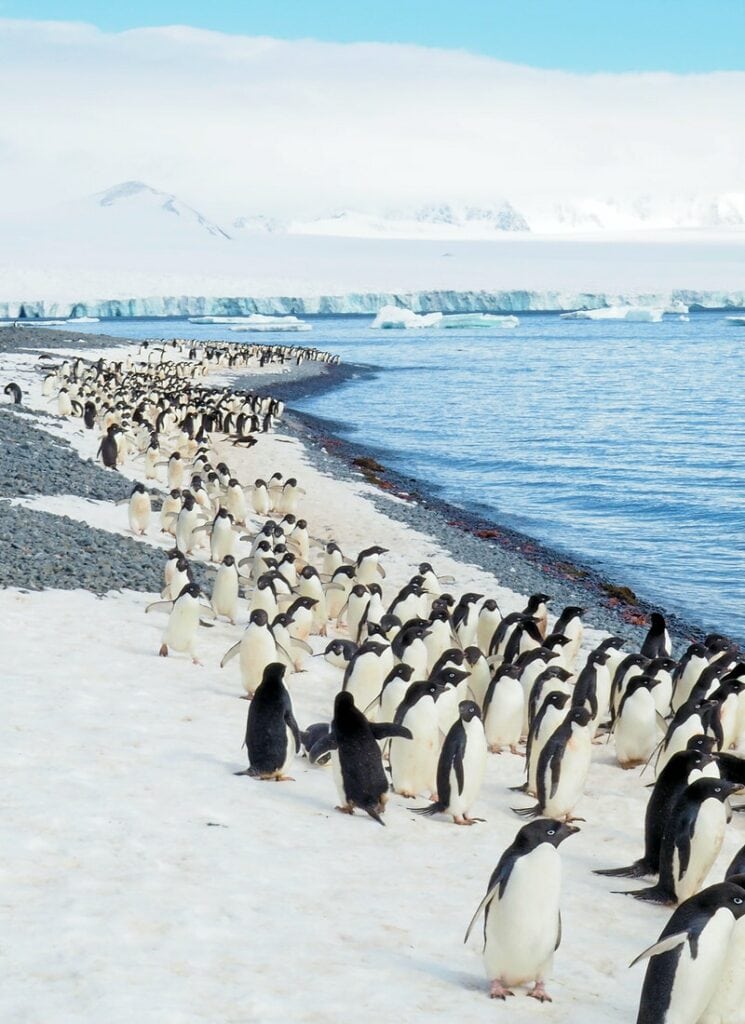
The classic tuxedo silhouette — stocky, upright, black-and-white with no markings whatsoever. Adélies nest further south than gentoos or chinstraps and have a particular habit of walking in long, purposeful columns across snow slopes that produce extraordinary wide-angle images. They are also notoriously bold: they’ve been known to peck at Zodiac tubes and have strong opinions about anyone standing between them and where they’re going.
Best for: wide environmental shots with colony in context. The clean silhouette reads from a long distance against snow or ice.
The One Worth Flying For
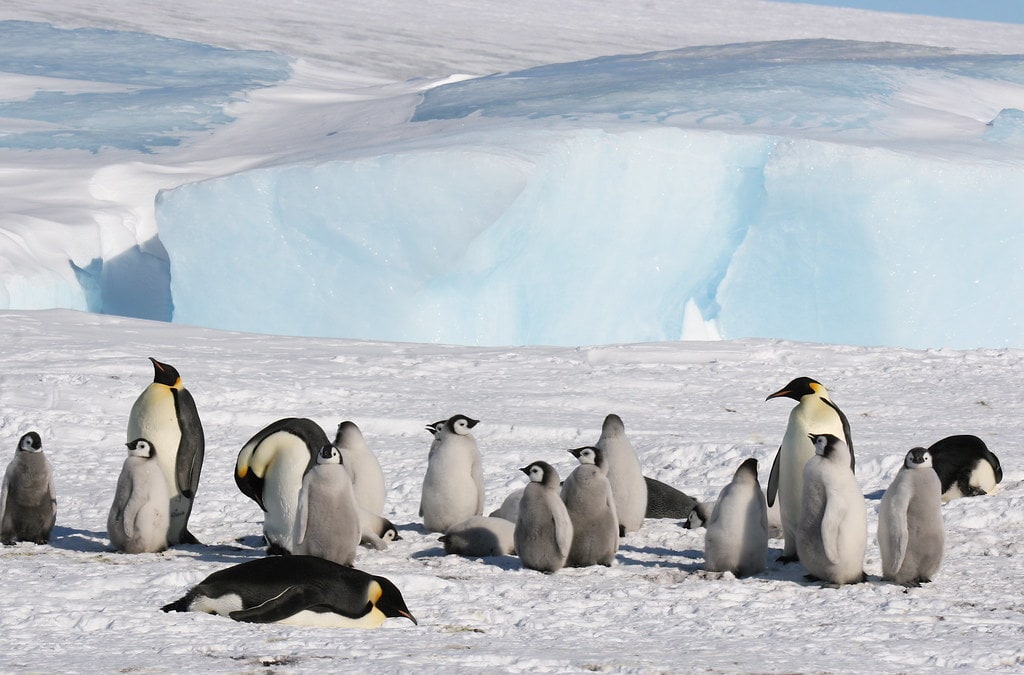
Everything above is reachable by cruise. Emperor penguins are not. The largest penguin on Earth — up to 1.2 meters tall, 40 kilograms — breeds on the sea ice of the Weddell Sea coast, accessible only by Twin Otter from Union Glacier (Gould Bay) or by flight from White Desert’s Wolf’s Fang (Atka Bay). The colony at Gould Bay holds several thousand birds. Unlike the smaller species, emperors move slowly, stand still for long periods, and are — in a way I find difficult to describe in print — profoundly calm. They will approach you. They will look directly at your camera. The yellow-gold patches at their neck glow in polar light in a way that no photograph I’ve seen has ever quite done justice to.
Best for: everything. Scale, colour, comportment, and context — sea ice, polar light, −30°C — produce images with no equivalent in wildlife photography.
Emperor penguins are the reason some couples choose the fly-in over the cruise. A colony of several thousand birds on sea ice at −30°C, in polar light, at arm’s reach. I don’t oversell it. I don’t need to.
Whales:
The Scale That Changes the Frame
Whales in Antarctica are not a bonus. In peak season from December through March, feeding aggregations off the peninsula are dense enough that encounters on a landing day are more likely than not. What changes the photograph isn’t the whale itself — it’s the scale. A humpback surfacing 30 meters from a Zodiac renders the Zodiac, and everyone in it, comically small. That sense of being genuinely tiny next to something genuinely enormous is one of Antarctica’s most disorienting and compelling photographic qualities.
The most commonly encountered large whale on the peninsula. Humpbacks feed actively in the bays throughout summer — lunge-feeding, bubble-netting in groups, fluking as they dive. When a humpback tail-slaps next to a Zodiac, everyone in the boat goes quiet. Then, usually, they laugh. The fluke pattern on the underside of the tail is unique to each individual — a detail that registers completely differently in photographs than it does in person, six meters from you on the water.
Best for: Zodiac-level perspective — whale surfacing with your couple in foreground. Requires patience and the right water position.
Orca sightings are not guaranteed, but when they happen they’re unambiguous — a high dorsal fin cutting the surface, usually in a group, usually hunting. Antarctic orcas are larger on average than populations elsewhere. Where humpbacks feel chaotic and joyful, orcas feel intentional. The black-and-white colouration against the grey-green Southern Ocean creates a high-contrast graphic image unlike any other wildlife encounter here. Pack ice zones and fjords near the peninsula are the most reliable areas for sightings.
Best for: wide shots from deck or Zodiac — dorsal fins and blow against the horizon. Patience required. Worth every minute.
South Georgia:
Where the Scale Becomes Absurd
South Georgia is available only on extended cruise itineraries — typically three weeks or more. It is not part of standard peninsula cruises. But for couples willing to invest in the longer route, South Georgia is arguably the most wildlife-dense place on the planet: 400,000 king penguins, 100,000 elephant seals, tens of thousands of fur seals and wandering albatross, in a sub-Antarctic landscape of glaciers and mountains.
Southern elephant seals are the species that stops people mid-sentence. The males reach 4 meters and 2,000 kilograms. They lie on beaches in heaving, snoring, apparently boneless piles — occasionally rolling over one another with an indifference to personal space that is difficult to photograph without laughing. They also have enormous, dark, liquid eyes, and in certain light conditions those eyes produce some of the most unexpectedly intimate wildlife portraits I’ve ever made.
Timing the Wildlife:
What’s Active, Month by Month
🦭
Penguins nesting · Sea ice breaking · First humpbacks arriving
👶🐧
Chicks hatching · Whale feeding peaks · Emperor colonies active · Midnight sun
🐳🌞
Peak wildlife · Chicks growing · Orcas hunting · Maximum daylight
🐳
Chicks fledging · Whales still present · Fewer ships · Blue icebergs
❄️
End of season · Whales departing · Ice returning · Last sailings
I don’t arrange the penguins. This should be obvious, but I mention it because a lot of couples arrive with a specific image in mind — the one where a penguin is standing exactly there, looking in exactly this direction, while they hold hands in the foreground. That image exists. I’ve made versions of it. But it exists because I know how penguin colonies move, which direction they tend to walk, where they congregate at which time of day, and what happens to the light when they’re between us and the water. It doesn’t exist because anyone asked a bird to cooperate.
What I’m actually doing while you’re on a landing is reading the environment continuously: where the animals are, where they’re going, how the light is moving across the colony, which angle puts the glacier behind you and the penguins in the midground without a Zodiac in the background. I’m not waiting. I’m positioning. That’s a different thing.
The encounters you can’t predict — a whale surfacing 15 meters from the Zodiac, a leopard seal sliding off an ice floe directly toward the landing site, a group of emperor penguins deciding that you are personally interesting and walking over — those are not planned. They’re responded to. Thirteen years of doing this in extreme conditions means the response time is short and the camera is already where it needs to be.
The wildlife is half the images
Emperor penguins
or humpback whales —
tell me which one you want.
The species you encounter depends entirely on when and where you go. I help couples choose the route and season that matches the wildlife they’re after — and then I position for the shots when we get there.
Tell me what you’re afterNo commitment. Just a conversation about whether Antarctica is the right fit for you.
The Numbers
Budget Breakdown:
What an Antarctica Elopement Really Costs
Most destination travel guides are coy about money. This one isn’t. An Antarctica elopement is expensive — in some configurations, extremely so — and the couples who work with me are better served by clear numbers than by vague gestures toward “investment.” What follows is the most accurate breakdown I can give you based on current operator pricing, with the caveat that costs change between seasons and all figures should be verified directly with operators before committing.
The range is genuinely wide: from around $19,000 for a no-frills expedition cruise for two, to well over $230,000 for a White Desert fly-in with the South Pole and emperor penguins included. Both are real Antarctica. The right one depends entirely on your priorities.
The Big Picture:
Expedition Route Costs at a Glance
The Full Breakdown:
Line by Line
← Scroll to see full table →
| Cost item | Low end | High end | Notes |
|---|---|---|---|
| Expedition — the core trip | |||
| Expedition cruise 2 passengers · 10–15 days | $16,000 | $100,000+ | Mid-range ships at the low end; ultra-luxury extended itineraries (South Georgia + Falklands) at the high end. All meals and landings included. |
| Fly-in · ALE / Union Glacier 2 passengers · 4-day base | $70,000 | Variable | ~$35,000 per person for the 4-day Union Glacier base. Three Glaciers Retreat and South Pole supplements are additional — on application. |
| Fly-in · White Desert 2 passengers · 6–8 days | $143,000 | $230,000+ | From ~$71,500/person for 6 days (Whichaway or Echo). ~$115,500/person for 8-day itinerary including South Pole + Emperor penguins. Private Gulfstream surcharge on top. |
| Getting there | |||
| International flights Per person · Economy to business class | $1,500 | $4,000+ | To Ushuaia, Punta Arenas, or Cape Town. Business class on long-haul routes recommended — you’ll arrive in better shape. Budget $3,000–$8,000 per couple in total. |
| Gateway city accommodation Per couple · Buffer days included | $300 | $1,500+ | Plan for 2–3 nights either side of the expedition in Ushuaia, Punta Arenas, or Cape Town. White Desert offers pre-departure accommodation in Cape Town on request. |
| Equipment | |||
| Polar gear (if purchased) Per person | $1,500 | $3,000 | Base layers, mid layers, hardshell, insulated boots, gloves. Most cruise operators provide outer parkas and rubber boots. Fly-in operators provide full gear lists and loan equipment — confirm before buying anything. |
| Ceremony | |||
| BAT marriage licence If legally binding ceremony required | £1000 | £1000 | Fixed fee. Payable to the British Antarctic Territory Administration. Applies to Peninsula cruises only — not to fly-in interior expeditions. |
| Photography & Planning | |||
| Zephyr & Luna Photography + full expedition planning | On request | Includes operator coordination, gear brief, BAT paperwork support if applicable, full expedition photography, and post-production. Pricing varies with trip type and duration. | |
What You’re Actually
Looking At, All In
Expedition cruise + international flights + gear. No BAT licence. Most accessible entry point into Antarctic elopements.
Quark / Silversea / Aurora level, or ALE Union Glacier base + flights. The mid-tier for most couples who contact me about Antarctica.
The complete interior experience. Flights, all accommodation, guiding, South Pole, emperor penguins. The most comprehensive Antarctica elopement available.
The couples who’ve had the best Antarctica elopements I’ve photographed were not the ones with the biggest budgets. They were the ones who understood exactly what they were buying — and chose the version that matched who they actually are.
Let’s find the right version for you
$19,000 or $260,000.
The right answer depends
on who you are.
I work with couples across the full budget range — from peninsula cruises to White Desert South Pole packages. The first conversation is about figuring out which version of Antarctica actually fits your priorities, not the most expensive one I can suggest. Let’s talk.
Let’s figure out your budgetNo commitment. Just a conversation about what actually makes sense for you.
Working Together
How I Can Help You Plan
Your Antarctica Elopement
13 Years. 24 Countries.
One Category Apart.
I’m Amber, the founder of Zephyr & Luna. Since 2013 I’ve been coordinating destination elopements across 24 countries — from Jordan to Patagonia, from Norwegian fjords to Icelandic volcanoes. In that time I’ve planned over 300 projects and developed a very specific skill set: reading locations for their photographic potential, coordinating complex multi-country logistics, and making sure that on the day, the only thing a couple needs to do is show up.
Antarctica sits in a category by itself. It’s the only destination I work in where the logistics are genuinely expedition-level: charter flights to glacial runways, ship operators governed by international environmental treaties, a legal marriage framework administered by the British government, and photography conditions that require serious technical preparation. I take this destination more seriously than any other I work in — because it demands it, and because the couples who choose it deserve someone who has done the preparation.
What I offer for an Antarctica elopement is not a photography-only service. It’s a complete expedition package: I am the planner and the photographer, operating as a single point of contact from the first conversation to the final image delivered. That integration matters more here than anywhere else I work — because the planning and the photography are inseparable. The images that make Antarctica extraordinary are the ones that come from understanding the light windows, the wildlife patterns, the weather, the operator protocols, and having the right gear for −30°C. You can’t photograph it well without planning it well first.
What I Handle
So You Don’t Have To
I work with a small number of Antarctica couples each season — this is not a volume business. If Antarctica is genuinely where you’re going, get in touch early. The best dates and the most flexible planning windows go to the couples who start the conversation first.
Before You Write
FAQ — Honest Answers to the
Questions You’re Actually Asking
These are the questions I receive most often from couples considering an Antarctica elopement. Plain answers, no padding.
You’ve read the whole guide
If Antarctica is where
you want to go —
let’s make it happen.
The planning starts with one conversation. No commitment, no package to choose, no form to fill — just a direct message about what you’re imagining and whether I’m the right person to help you build it.
You show up. I handle the rest.
Based in France. Available worldwide. Antarctica every season.